


 Page Type:




nader - Oct 12, 2007 2:09 pm - Voted 10/10
InterestingI don't do any winter climbing but this was a very interesting home experiment.

Anya Jingle - Oct 12, 2007 9:26 pm - Voted 10/10
I agree with NaderThanks for putting the effort for this interesting experiment. I have tried various thermoses, but REI one has been my favorite. There is nothing like a hot apple cider on a cold winter summit!

CookieMonster - Oct 12, 2007 11:57 pm - Voted 10/10
Could also add agitationTry agitating the water a little - like what would happen while you are walking. This will help the water to freeze, especially if it's very pure (i.e. filtered water) because the water needs some impurities to start growing an ice crystal. With pure water, you might find it well below 32F and not frozen until you shake it! Nice experiment.

Dan Dalton - Oct 14, 2007 2:03 pm - Hasn't voted
Reminds me of a middle school...science fair project. Really cool and unefull information Scott. Great idea.
Dan

Andino - Oct 15, 2007 10:06 am - Hasn't voted
Also interesting...is to see the pipe of a camelbak freezing and getting useless, below 0°C.

itpimps - Oct 17, 2007 2:11 pm - Voted 10/10
Re: Also interesting...I agree, my insulated camelbak tube has helped to keep water cool in summer as well as freezing in winter, but it has frozen over many times while I ski. I've found one of the best ways to prevent freezing in the tubes was to blow all the water back into the bladder because the water within the tube was an easier target for freezing. I'd love to see an article comparing the various bladder tube assemblies and the "insulation".
Great read-I'll have to checkout the REI insulated thermos...

Saintgrizzly - Oct 17, 2007 2:32 pm - Voted 10/10
Very worthwhile page......I see an REI purchase in the near future! Sometimes, I've even taken a stove just to melt snow—obviously cumbersome and time-consuming! Thanks for making the effort on this, Scott!

zenalpinist - Oct 17, 2007 3:52 pm - Hasn't voted
Another thing to note......is that as you drink water from said bottle/thermos, the volume decreases and becomes more able to freeze. From pure field observations (not scientifically setup) I have inserted two nalgenes into identical OR sleeves with warm water, one full and the other a bit less than half full. After several hours of skiing around, the bottle with less water has begun to slush-up and freeze, while the full bottle is still warm.
So keep that in mind as water gets drunk from the bottle, the system is changing. On some very cold days I've had the bottom 10oz or so freeze solid and I just have to switch to another bottle.
itpimps - Oct 17, 2007 4:10 pm - Voted 10/10
Re: Another thing to note...Great point!

jvarholak - Oct 17, 2007 6:52 pm - Hasn't voted
great info...thanks for your work....can you post the weights of each bottle tested?...or...i guess i can stop being lazy and look them up myself :)

Trevor Simmons - Oct 17, 2007 10:14 pm - Hasn't voted
thanks ScottValuable experiment for all of us that venture out in the cold months...

Josh_Inked - Oct 18, 2007 1:03 am - Voted 10/10
Thanks....Thanks for the experiment. It is one more valuable tidbit to take into acount.

Boriss Andean - Oct 18, 2007 1:27 am - Voted 10/10
Very useful information...Thanks for posting this article Scott.
Boriss...

baloodh2000 - Oct 18, 2007 10:11 am - Hasn't voted
Good InfoThakns for the home experiment. Gearing up for my first winter mountaineering season. Really usefull!

Smith93 - Oct 18, 2007 1:49 pm - Hasn't voted
And the winner is...Awesome! I'm excited that the REI thermos performed so well. I'll have to remember that the next time I'm at work.

Snowpuppy - Oct 19, 2007 9:07 am - Hasn't voted
Very InterstingWay cool, now I can pull my thermos out of storage!!

dpk - Oct 19, 2007 9:17 pm - Voted 10/10
dont drop your bottleAlso as a note - frozen nalgene bottles can shatter if dropped on large rock from slight distance - but thats about the only time a Nalgene will break
Good stuff here - I also use a thermos as well

gomez13 - Oct 20, 2007 10:32 am - Hasn't voted
nice experimentGood beta I just had two nalgene bottles freeze solid on me on Mt Langley a couple weeks ago. the REI thermos seems like the way to go

BigLee - Oct 20, 2007 5:07 pm - Hasn't voted
InterestingDo you work for REI? What do you reckon the difference between the two thermos is due to?

Scott - Oct 20, 2007 5:21 pm - Hasn't voted
Re: InterestingDo you work for REI?
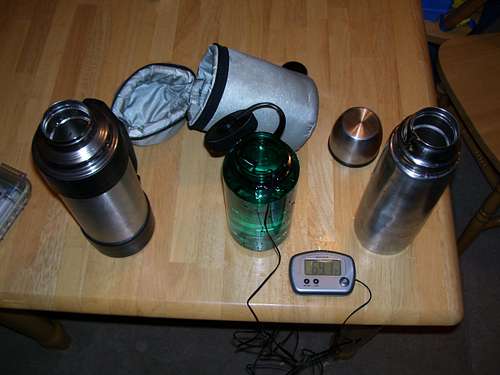
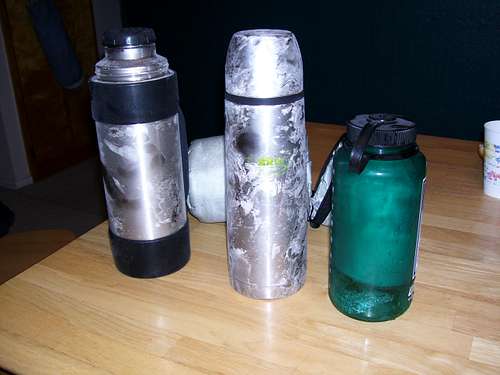
Nope. Actually I just threw this experiment together to answer a question on the 14ers.com forum. I disagreed that Nalgene jackets are always adequate for winter climbs in this area and since I already wrote it all up, I thought I'd copy my forum post over there as an article over here as well. Here's the thread and my first post if you want to read it:
Thread
The same article here is the forum post at the beginning of page 3.
What do you reckon the difference between the two thermos is due to?
The REI one is definately better built. On the other hand, it's also almost 3 times more expensive, so it should be better built. The Walmart thermos is probably more meant for taking hot beverages to work or maybe the ski slopes; the REI for the outdoors. I'm actually surprised the Walmart thermos did so well. I still wouldn't want to drop it too many times, but it is still better than just a Nalgene with a jacket.
Comments
Post a Comment