


 Page Type:
 Activities:

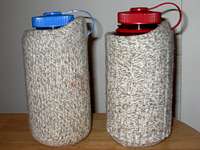

rhyang - Feb 12, 2007 5:50 pm - Hasn't voted
Good startOutdoor Research also makes insulators for nalgene bottles you can strap to your waistbelt, etc.

Not as cheap or as light as an old wool sock, of course.

lalpinist - Feb 12, 2007 6:59 pm - Hasn't voted
Re: Good startExpensive and bulky, but much slicker.
rhyang - Feb 12, 2007 7:03 pm - Hasn't voted
Re: Good startI would never pay retail for these of course (I think Altrec.com has them on sale right now). But bulky ? One thing about them is that you can attach one to your waistbelt and free up pack pocket space for snacks or what have you. I suspect that they also offer more insulation as well.
On multipitch ice routes where I think I might want to carry some water I attach one to the haul loop on my harness in back.
When I first got into snow-camping I actually made something similar out of duct tape and a piece of old sleeping pad foam. Now that was heavy and bulky :)
lalpinist - Feb 12, 2007 7:40 pm - Hasn't voted
Re: Good startThe waistbelt approach mitigates towards the commercial solution, too, as with more exposure to the air, you'd want something that completely encloses the bottle.

Rob A - Feb 14, 2007 5:38 pm - Hasn't voted
Re: Good start water bottle parka
it works great

b_betts - Feb 18, 2007 7:14 pm - Hasn't voted
Re: Good startI still use the foam & duct tape insulation method! :)

nartreb - Feb 12, 2007 8:44 pm - Hasn't voted
why mess around?http://www.summitpostgear.com/gear/1242/stainless-steel-thermos.html
Worth every gram.

rasgoat - Feb 12, 2007 10:52 pm - Hasn't voted
orThis
Combined with Nalgene/Parka
The Nalgene bottle parka kept the water warm all day in 15 degrees with good winds and I had it attached to the lower section of my backpack's shoulder strap. It rested nicely at my side, unobtrusive and easily accessed. I do not like to have to take off my pack for every sip of water. I am confident the water would not freeze in much colder temps. Even exposed as it was.

Poor Climber - Feb 13, 2007 7:23 pm - Voted 10/10
Good articleI really appreciate that you pointed out that keeping the nalgene upsidedown lets you drink from it longer.
Back when I used to do winter adventure races; the people who knew what they were doing used nalgenes stashed in their packs upsidedown; and NEVER used hydration packs if the forecast called for below freezing temperatures.

96avs01 - Feb 13, 2007 8:12 pm - Hasn't voted
Just a tipYou can still use your hydration bladder in the winter with an insulated drinking tube. The catch is that after each drink you need to blow all of the water in the tube back into the bladder. This keeps the tube free from potential freezing and allows for a more convenient hydration option than a Nalgene buried in your pack. One caveat is that you need to be selective in the type of bite valve you use as certain brands have the potential to freeze with the minimal amount of residual water from the tube, I have experienced this problem with the Nalgene bite valve, but have always had an ice-free experience with the Camelback big-bite valve. Just my 0.02
lalpinist - Feb 13, 2007 10:27 pm - Hasn't voted
Re: Just a tipGreat tip! Thanks.

WalksWithBlackflies - Feb 22, 2007 5:21 pm - Voted 10/10
Re: Just a tipIt's been my experience that you DO NOT want to blow on the tube. It pressurizes the bladder, which then forces the liquid back into the tube. Instead, squeeze the bite valve above your head in a Statue of Liberty pose. The liquid will run down into the bladder without pressurizing it. When you return the hose/bite valve to its normal position, be sure to squeeze the bite valve again to release the few drops that dripped down the hose. In this way, I have used insulated bladders to -10F with no problems (I haven't been able to test it in lower temps for extended periods of time).
96avs01 - Feb 22, 2007 6:44 pm - Hasn't voted
Re: Just a tipI have never had a bladder force the water back into the tube. I have attempted your method and found that when my hydration bladder was in a tightly-packed backpack against my back there was enough pressure on it to force water out of the hose while holding the bite valve open. My previous experience with Camelback, Nalgene and Platypus bladders has never once yielded a frozen hose with the blow back method, however the bite valves are another story as described above.

ReticentMarvel - Feb 13, 2007 9:11 pm - Hasn't voted
In a pinch...This works:
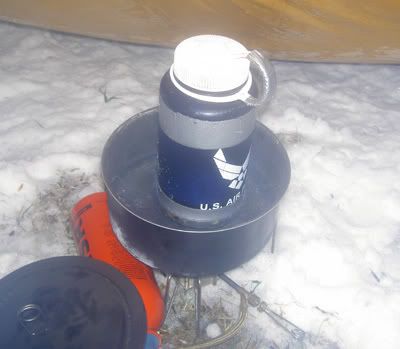
My waterbottle froze solid overnight (oops - should have kept it in the sleeping bag). The water in the pot kept the nalgene from melting. Took forever though. And I agree that hydration packs are a bad idea. If it's not that cold you can make it work, but on a really cold day blowing out the water doesn't stop it, putting the tube in a sleeve in your jacket doesn't stop it... Never again.

Dmitry Pruss - Feb 13, 2007 9:31 pm - Hasn't voted
_old_ sock?Why carry extra weight? I just use a regular spare layer for insulation, a sock or a glove maybe. And the bottles are filled with boiling hot water to begin with.

chrisferro - Feb 18, 2007 7:11 pm - Hasn't voted
Re: _old_ sock?Exactly, I'll take two bottles, fill them both up with hot gatorade, and wrap one of them up in my bivy jacket or spare mitten or something and stick it in the bottom of my pack. By the time I drink the first bottle, that second bottle is probably still hot.

nebben - Feb 13, 2007 11:38 pm - Voted 10/10
Upside downI never thought of that...good tip!
aemter - Feb 14, 2007 4:48 pm - Hasn't voted
Try a thermosI have to agree with the above post about using an insulated thermos. The weight of a 1L Lexan Nalgene bottle and an OR Insulated Bottle Parka is a combined 10.8oz. Now I'm sure that most thermos type containers will weigh more, but the thermos will keep your drink warm much longer than the Nalgene/Bottle Parka combination, not to mention the fact that you can get a good thermos for the price of the Bottle Parka alone (I got my SS Thermos for $10 on sale).

damio - Feb 14, 2007 5:00 pm - Voted 8/10
ditto the thermosIts -15C, night time, you are very cold, under the influence of altitude, tired and lagging in moral strength: there is nothing worse than forcing yourself to drink soon to be frozen water filtered through a honeycomb of ice slowly taking over the inside of your bottle, knowing that within an hour or so it will be a solid block, several hours before you are back in civilisation. It makes my throat lump just thinking about it.
I love my thermos.
Comments
Post a Comment