


 Page Type:
|
Route |
|---|---|
 Lat/Lon:
|
37.16690°N / 118.6706°W |
 Route Type:
|
Scramble |
|
Time Required:
|
A long day |
|
Difficulty:
|
Class 3-4 |

|
Approach
From the Lake Sabrina TH, follow the trail to Blue Lake taking the right fork to Dingleberry Lake. Yes, there is a lake by that name. Past Dingleberry Lake, take the right fork again to Midnight Lake (the left fork goes to Hungry Packer Lake). This last stretch is a fine example of what happens when a trail-building crew is given too much dynamite. Marvel at the nearly flat granite surfaces that are blasted away for no reason. Midnight Lake is 7.9 miles from the TH, and marks the end of the maintained trail.Pass Midnight Lake on the north and west side, heading up the canyon to Blue Heaven Lake. Secor suggests passing Blue Heaven Lake on the south and west side, which involves several hundred feet of downclimbing over and around a loose terminal morraine. Though I followed this suggestion, I'm not convinced that it wouldn't be better to climb directly up to the middle of the east side of the lake, and pass around the north side. In fact, Kevin Trieu reported that the approach via Hell Diver Lakes and the north side of Blue Heaven Lake works just fine.
Past Blue Heaven Lake, climb past the upper unnamed lakes on the east side, aim for an obvious scree chute to to the right of Darwin Col, just to the left of Peak 13,048ft. This chute is most easily climbed on the right side where you can get some purchase on larger rocks and some solid ground. The center of the chute makes for a swift and fun descent.
Climb to the north of the small peak and head for the Darwin Col. Gain the northeast ridge by the easiest route, generally class 2-3. With significant snow, crampons or axe might be helpful, but these are not needed in low snow years or late in the season. You are now positioned at the start of the NE Ridge route, which also serves as the start of the East Face, Right Side route.
 |  |  |
Route Description
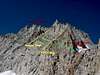
Climb a 60-foot class 4 chimney at the start of the NE Ridge route. You might think you could more easily bypass this to the left, but you can't. The center of the chimney has a large obstruction that serves as the crux of the climb. An awkward lieback of about 6 feet is required to surmount the difficulty, a solid class 4 section. Another climber reported that a line immediately right of this section was easier. The rest of the chimney is class 3.At the top of the chimney exit the ridge to the left. You have to traverse two gullies across two ribs to reach the main central chute. This whole face is loose and rotten, so use caution, particularly if climbing with others, or above or below other parties. Many rocks are likely to be dislodged while on the face, and they will travel long distances. There are no exact locations at which to cross the two ribs, but cairns have been used to mark the more popular locations. You can easily find your self on more than class 3 if you choose the wrong crossing point.
Once in the main chute, the easiest climbing is on the right side of the gully. Follow this up to the summit massif, then climb south to the detached summit pinnacle. Late in the season or during dry years, it is possible to climb the central chute up and to the left, which will bring you directly to the summit pinnacle. This second choice is steep and loose!
Climb down to the saddle between the summit massif and the detached pinnacle. The summit block is quite impressive from this angle, and looks impossible to climb. It is most easily climbed from the back side, which can be reached by going clockwise or counterclockwise around the pinnacle. Going clockwise, you may have to downclimb one snow chute and up another to reach the back side. Going counterclockwise is generally easier, but take some time. Secor was smoking crack when he wrote his description, so ignore it. On the right (counterclockwise) side, you can easily climb around to where there are two crack systems that can be climbed. The first is quite hard, the second easier. If you continue around to the backside, you find even easier climbing that allows you to avoid the difficult cracks. The trick here is that the final moves around to the backside from this side are rather exposed, even if they are relatively easy. Steady nerves required.
On the backside of the summit pinnacle, it is an easy class 3 climb up to the summit. Cherish the moment, and be sure to have your friends take your picture from the saddle around to the front.
 |  |  |
Bob Sihler - Jul 31, 2013 1:40 am - Voted 10/10
Great resourceI climbed this route two days ago and wouldn't have known about this route if not for this page. Some comments: * Distance to trail's end at Midnight Lake is much less than 7.8. By maps, it's 5.7, but I think there's an error in one section of the map and that the distance is really closer to 6. It took me 2 hours to get there. Although I can go fast, I cannot do 7.8 uphill trail miles in 2 hours! * You are right that going north around Blue Heaven Lake is better, but on the ascent, I went south and did not have to lose several hundred feet; I contoured pretty widely and kept the elevation loss minimal. * The "another climber" who reported that the right side of the chimney is easier is correct. But I would add that it is not a whole lot easier, is less direct, and involves more "pitches." * The main chute is virtually unclimbable at a certain point unless one does stay well to the right, where there is a tricky Class 4 move to get up what is the crux of that portion of the route. It's tricky and exposed enough that someone has left a nut and carabiner there for rappelling down the pitch, though I didn't use them since I had no rope. * Some of your pictures here were tremendously helpful! * There is no register on the summit block, but there is a weathered copy of Darwin's book. I could not find the register near the summit, either, as I did on Bear Creek Spire the day before. * In dry or late season, one can use a left branch of the left-branching final chute to go over, slightly down, and then slightly up to the easier side of the summit block without the exposed steps. I discovered this on the descent, alas... Thanks for this very useful page!