


 Page Type:
|
Mountain/Rock |
|---|---|
 Lat/Lon:
|
45.36600°N / 22.89300°E |
 County:
|
Hunedoara |
 Activities:
|
Hiking, Mountaineering, Trad Climbing, Skiing |
 Season:
|
Spring, Summer, Fall, Winter |
|
Elevation:
|
8232 ft / 2509 m |

|
Overview
 Vârful Peleaga -
  Pelága-csúcs
 The west face of Peleaga The west face of Peleaga |
|
 Peleaga from the distance Peleaga from the distance |
 West view from Peleaga
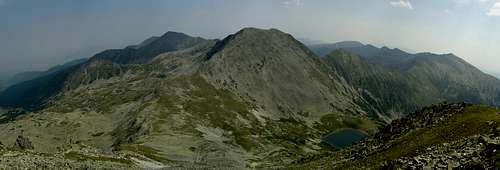 East view from Peleaga
Getting There
As Peleaga peak is located in the northern region of Retezat, I would suggest approching it from Nucşoara village. Getting to Nucşoara is described in detail on the Retezat Mountains parent page (follow instructions for North Retezat).
Alternatively, you might get a taxi to Poiana Pelegii campsite from Haţeg town, and stay there or hike up to Bucura Lake campsite. Bear in mind that the upper section of the road (from Rotunda hut) is often not passable for vehicles due to flood damage or fallen trees.
Routes
Hiking
Hiking routes in Romania are marked by red, yellow and blue colors, and use three shapes: stripe, dot and triangle. From this point, I will use abbreviations for these (for example: YT=yellow triangle, RD=red dot, BS=blue stripe, and so on...)
Peleaga can be scaled by following two marked paths (described from west to east, but of course they can be walked the other way as well):
- RS: coming from Curmătura Bucurei (saddle, 2206 m), via Custura Bucurei peak (2370 m) towards Păpuşa peak (2508 m)
- YC: coming from Bucura Refuge (2052 m) towards Păpuşa peak (between Peleaga and Păpuşa the same as RS)
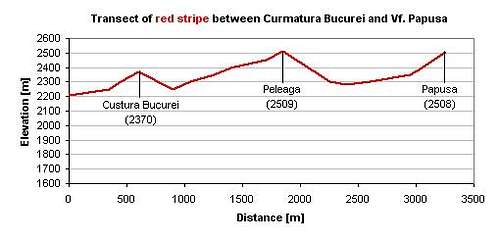
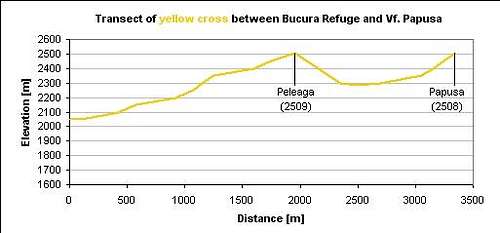
Neither of these paths require any climbing, but if you intend to come (or leave) from (or towards) either Bucura Lake or Păpuşa peak, be prepared for some steep sections with occasionally unstable ground. Take care not to kick rocks down on people below you. The YC signs get hard to spot after you reach the rocky region, because the lychen cover on the rocks has similar color. But anyway, you should follow the gradient up until there's no more gradient...
 Reaching the summit
Curmătura Bucurei is actually the junction of the west-east RS (which continues towards Bucura peak in the west) and the north-south BS (connecting Cabana Pietrele with Cabana Buta, via Bucura Lake and Poiana Pelegii). Thus, if you are staying at Bucura Lake, there are possibilities of doing circle-trips:
- small circle ("just" mountains):
Bucura Lake (2041) - YC - Peleaga (2509) - RS - Custura Bucurei (2370) - RS - Curmătura Bucurei (2206) - BS - Bucura Lake
|total elevation gain: ~480 m| - large circle (includes passing by a handful of tarns):
Bucura Lake (2041) - YC - Peleaga (2509) - RS - Custura Bucurei (2370) - RS - Curmătura Bucurei (2206) - RS - Bucura peak (2433) - RD - Tău Porţii (2230) - RD - Florica Lake - RD - Viorica Lake - RD - Ana Lake - RD - Bucura Lake
|total elevation gain: ~700 m|
From Şaua Pelegii (the saddle between Peleaga and Păpuşa peaks, 2285 m) there are further marked paths to Pietrele hut (RS, then YT) and Genţiana hut (RS, YT and RC).
Climbing
|
If you are a climber, then Colţi Pelegii is the way to go.
The following list of climbing routes is adopted from this external source (you can also find hand-drawn sketches here). Difficulty ratings are according to the Russian grading system, which is used in Romania.
|
|
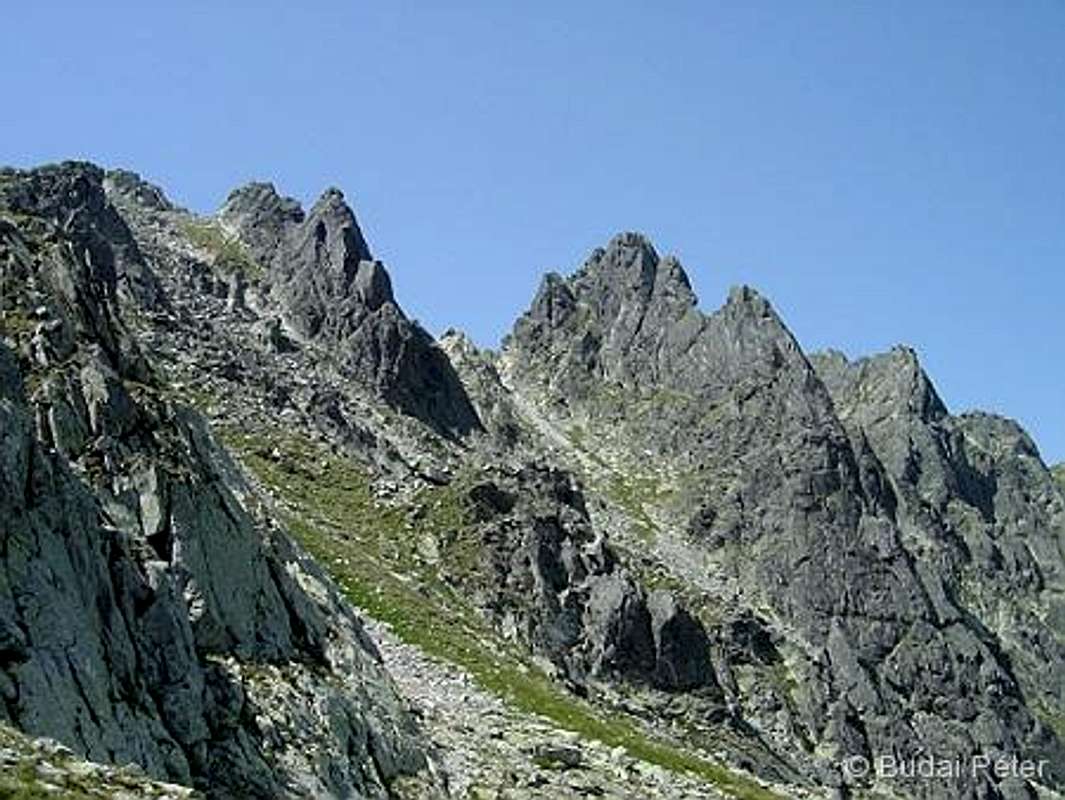 Colţi Pelegii
Red Tape
 Take care of us!
Vf. Peleaga is inside the territory of Retezat National Park (further information about the park itself can be found on the Retezat Mountains parent page). It is forbidden to leave trails, camp outside of designated sites, or put up a fire. Swimming is prohibited in Bucura Lake (and the others as well, I suppose). If you plan to climb, it might be advisable to contact the National Park administration (see External Links section below) and/or Salvamont (Mountain Rescue, see Retezat Mountains parent page) in advance.
You should bring all your trash back down with you when leaving (just like elsewhere)! Please do a favour for the mountains by fetching garbage that others have left behind (furtunately this does not happen very often, but if you look, you'll find).
Beginnig from May 2010, a small admission fee of 5 RON shall be paid upon entry into the National Park. The ticket is valid for 7 days, independently of the number of entries within this period. The main NP visitor center is located by the road about halfway between Mălăieşti and Nucşoara villages.
Huts and Camping
The closest huts are Cabana Genţiana (1670 m) and Cabana Pietrele (1480 m). The latter consists only of scattered bungalows and a designated campsite now, since the old hut burned down in February, 2007. From either of these huts, follow the BS until Curmătura Bucurei (Bucura saddle) and turn left (east) on RS.
The nearest campsite is the one at Bucura Lake. From here to the peak it takes about 1.5 hours on the YC (ascending ~460 m). From Poiana Pelegii campsite the ascend is about twice as much (~900 m) - first you have to get to Bucura Lake on BS/RC combo. From Stâna din Râu campsite it is even more demanding, since you have to scale Păpuşa peak first (~900 m up), descend from there (223 m down), and then ascend to Peleaga (224 m up). There is an emergency bivouac place just below the summit, but it has only a circular rock fence against wind.
More information about these campsites and huts can be found on the Retezat Mountains parent page.
When to Climb
The most welcoming weather can be anticipated around late summer - early fall, when precipitation is relatively little, but temperatures are still warm. Though it is not impossible to ascend the peak in the winter, you have to be an experienced mountaineer to do it safely, as the chances of avalanches is generally high in the area. There is no mountain rescue service in this time of the year, either (see Retezat Mountains parent page). Probably it's safer to go if you have already been there in the summer, and know the terrain.
 Perfect summer weather around Peleaga in the end of July.
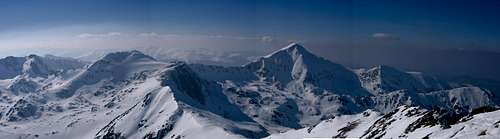 Perfect winter weather around Peleaga in March.
Weather
Below you can find a weather forecast for Peleaga peak by viewweather.com:
Maps
Paper maps
See the Retezat Mountains parent page.
Online maps
A powerful free online map is being developed by the Open Maps Project for the area of Central Europe. If you are not familiar with the area or want to skip the zooming job, you can get a quick close-up view of Peleaga's area by following this permalink.
Miscellaneous
For some useful travel information about Romania, check out this page.
External Links
Retezat National Park official homepage
Retezat on PAN Parks page: short introduction
Retezat page on alpinet.org: only in Romanian, but has up-to-date news section, maps (SRTM map, topo map) and huts info