

-
 19515 Hits
-
 85.87% Score
-
 21 Votes
 Page Type:
|
Mountain/Rock |
|---|---|
 Lat/Lon:
|
43.78831°N / 110.76791°W |
 Activities:
|
Mountaineering, Trad Climbing, Scrambling |
 Season:
|
Summer |
 Elevation:
|
11144 ft / 3397 m |

|
Overview


In Guide to the Wyoming Mountains and Wilderness Areas by Orrin and Lorraine Bonney, the authors write that Rockchuck Peak is named for its "primary denizen." So what is a rockchuck? I had never heard the term before, but thinking of a woodchuck got me to thinking that a rockchuck must be a marmot, and that was correct; rock chuck is another term for a yellow-bellied marmot.
Ironically, I did not see a single marmot while climbing this peak.
Everyone who gazes at the Tetons from Jackson Hole (the portion of the valley north of Jackson and within Grand Teton National Park, that is) sees Rockchuck Peak. It is one of the "front peaks" of the range, the next peak north of Mount St. John and connected to it by a Class 5 ridge (according to Bonney, it is 5.0 on rotten rock, but beware-- he has "Class 4" routes in his guide that are actually known to be 5.6 or harder), and the peak on the southern side of the mouth of Paintbrush Canyon (people hiking up or down Paintbrush Canyon traverse around the northeastern base of the peak).
First climbed on August 16, 1929, by Fritioff Fryxell, the first park ranger here and a climbing pioneer in the Tetons, the peak seems fairly popular now because of its accessibility, though it is by no means subject to heavy traffic; one should not be surprised to encounter one or two other parties but should be surprised to encounter more than that. I found no register up top.
Views from up top are spectacular. Mount St. John is practically in your face just to the south. Beyond it looms the summit of the Grand Teton. To the west is Mount Fryxell and Paintbrush Divide. Mount Woodring, Thor Peak, and Mount Moran dominate the scene to the north. Views to the east stretch past Leigh and Jenny Lakes, across Jackson Hole, and to the Mount Leidy Highlands and the Gros Ventre Range. Far below is beautiful Paintbrush Canyon, with Holly Lake clearly visible. On very clear days, peaks in the Absaroka Range and the Wind River Range are visible as well.
Routes
The Bonneys list six different routes ranging from Class 3 to 5.3 (one of these is the 5.0 traverse between Rockchuck and St. John):
East Slopes-- Class 3
Northeast Ridge-- Class 4
Northwest Ridge-- Class 4
Wilson Route (West Face Couloirs, Southwest Ridge)-- 5.3
Traverse to/from St. John-- 5.0
Southeast Face Couloir-- 5.2
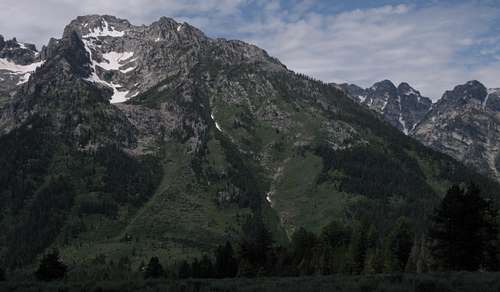 A look at the east slopes and northeast ridge routes
 2 Routes