

-
 45802 Hits
-
 96.63% Score
-
 61 Votes
 Page Type:
|
Mountain/Rock |
|---|---|
 Lat/Lon:
|
48.77700°N / 113.726°W |
 Activities:
|
Hiking, Mountaineering, Scrambling |
 Season:
|
Summer, Fall |
 Elevation:
|
8851 ft / 2698 m |

|
A Problem of Shakespearean Proportions
Pictorial Introduction to a Nice Mountain
History of an Area
 George Bird Grinnell
A SINGULARLY IMPORTANT INDIVIDUAL He was many things: scientist, hunter, explorer, naturalist, entrepreneur and author. Above all else, however, George Bird Grinnell was and remains the most influential conservationist in North American history. —All quotes are from "The Father of American Conservation," by Shane Mahoney, The Bugle, Vol. 21, #6, and Vol. 22, #1. The article may be read in its entirety by following the links at the end of this section.  Indigenous life form
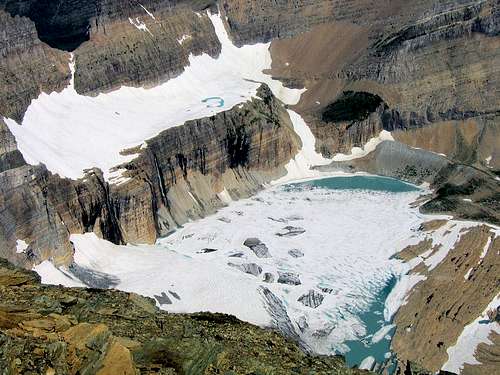
Mount Grinnell is named after George Bird Grinnell (1849-1938), who, beginning in 1885 led several exploratory trips into the area. In 1887 he and his party were the first white men to explore the valleys around what is now Swiftcurrent Lake, and were so impressed by the massive glaciers there that members of the expedition—on the spot—named one of them after their leader. More than any other single individual, Grinnell was responsible for the establishment (he was influential in the legislation leading to such), in 1910, of Glacier National Park. He authored many books, primarily dealing with the Plains Indians cultures, and with legends and lores of the Native Peoples in and around what is today Glacier National Park. Some of these books are still in print, and readily available even today.
Earlier, in 1875, Grinnell had taken a trip to Yellowstone National Park "...as a naturalist with a government-sponsored reconnaissance under the command of Colonel William Ludlow. Their visit confirmed big game was being slaughtered and timber and other resources extracted at a vicious pace. Grinnell returned from the expedition determined to provide better protection for the park and to set before the American people a platform of discussion regarding just what a national park should represent. In so  Final summit approach
doing he was to lay the foundation for the national park system we have today." A few years later, in 1883, as a reaction against the wholesale slaughter of birds for the purpose of decorating ladies' hats, Grinnell used his position as founding editor of Forest and Stream Magazine (today, Field and Stream Magazine) to publish a series of articles against the wanton killing of birds (and wildlife in general) for frivolous purposes, and was one of the founders of the American Ornithologist's Union. Three years later he founded The Audubon Society (today known as The National Audubon Society). George Bird Grinnell was amazing!
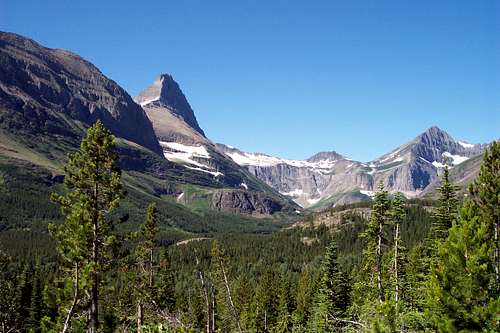
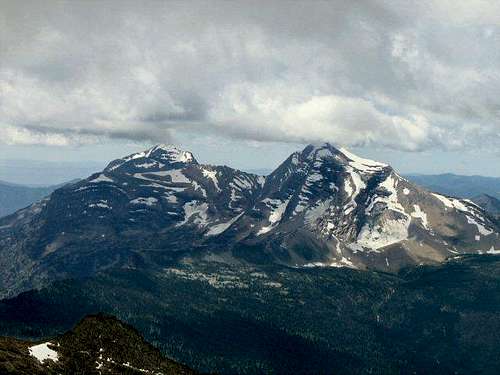
GNP has three important features named after this man: the mountain bearing his name, Grinnell Glacier, and one of the first impressive geological features seen when entering the Many Glacier area, Grinnell Point (originally known as Stark Peak, after an early day miner in the area named Parley Stark—later changed to the name it is known by 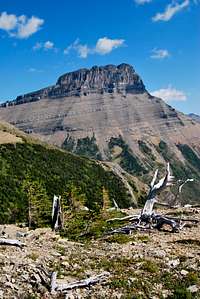 Mt. Wilbur,from the south Mt. Wilbur,from the southtoday) which is not the mountain it initially appears to be, but "merely" the titantic end of the ridge running eastward out of Mount Grinnell proper, which cannot be seen from the road. What the early explorers accomplished in their exploration of this inhospitable area, which must at times have seemed almost completely inaccessible, is remarkable. What they achieved in their relationships with the Native Peoples already living on this land showed both courage and sensitivity, and is also remarkable. We owe an immeasurable debt to George Bird Grinnell and others of that era! Indicative of the high regard in which this man was—and is—held, it is interesting to note that he is responsible for the naming of more features in GNP than any other single individual, personally naming many mountains, lakes, ridges, and passes. _____________ These links will take you directly to the (truly!) excellent and readable article mentioned above (The Bugle is the journal of The National Elk Foundation): The Father of American Conservation, Part 1 The Father of American Conservation, Part 2
Views from the Upper Reaches
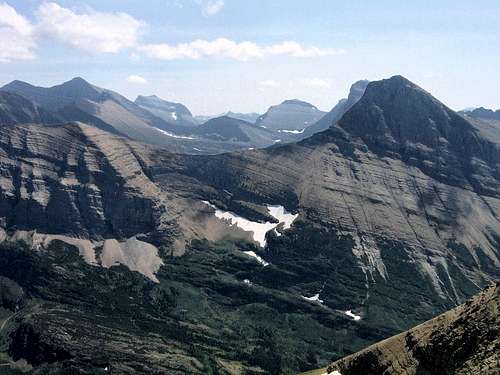
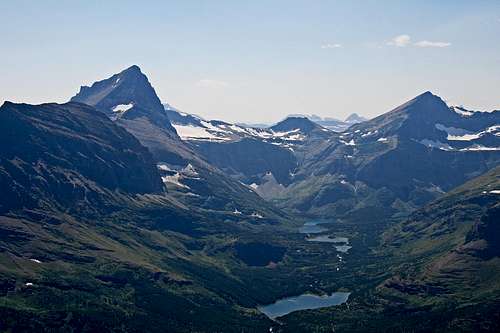
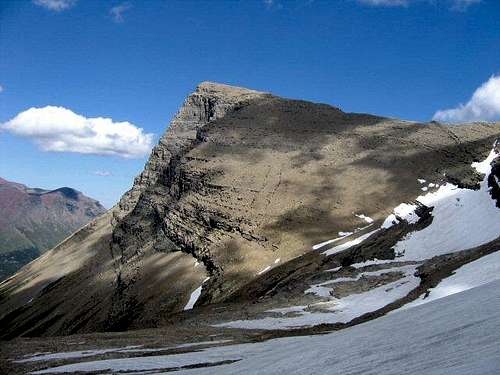
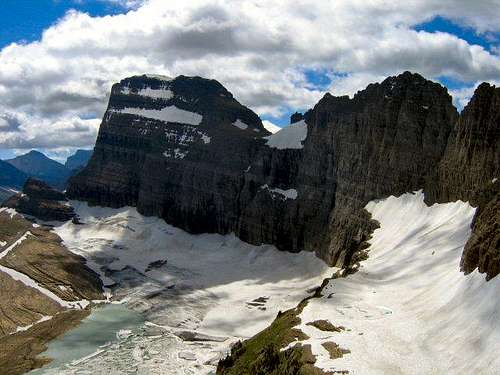
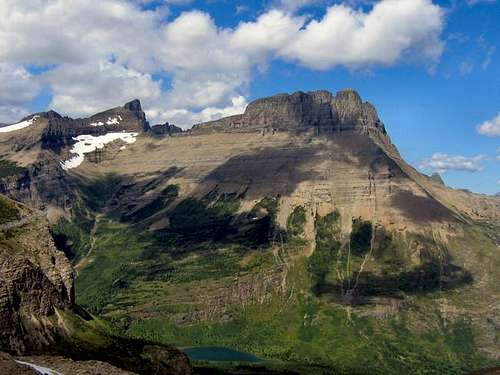
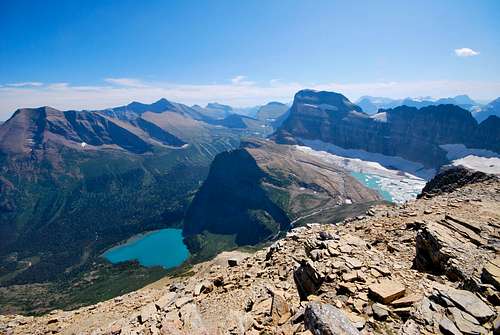
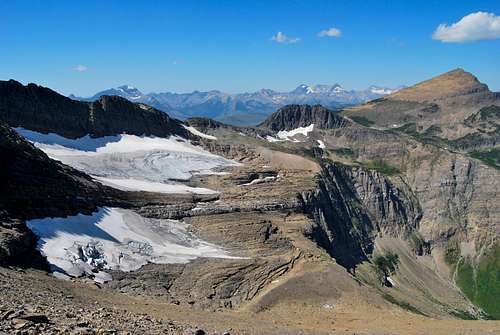
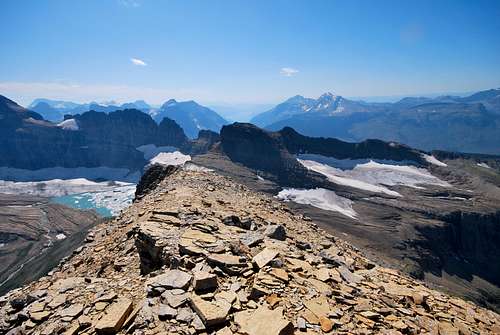
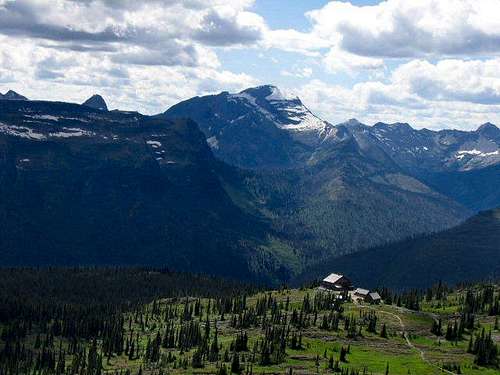
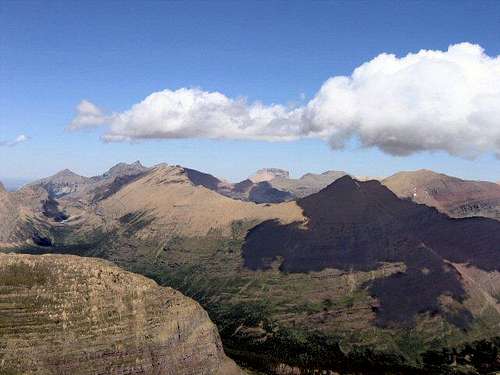
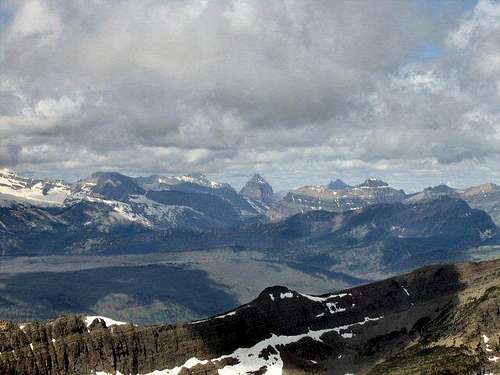
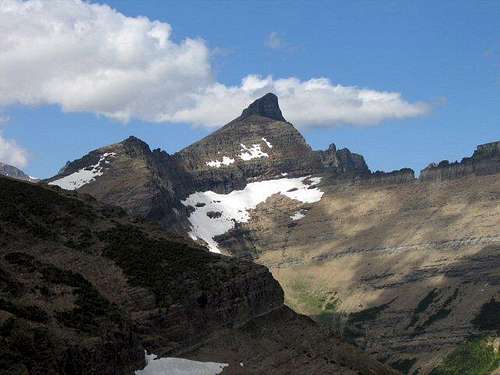
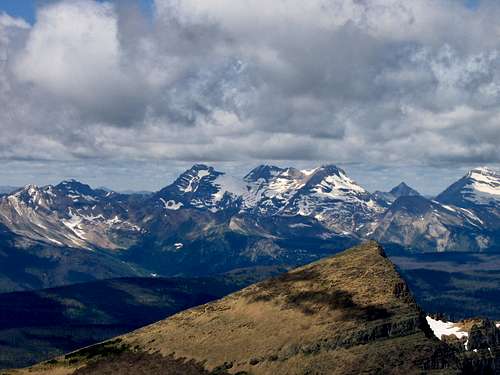
Location & RoutesMount Grinnell is located at the western edge of GNP's Many Glacier Area, lies approximately equidistant between the neighboring major peaks of Mount Gould (S) and Mount Wilbur (N), with the basin immediately to the west of Grinnell holding Swiftcurrent Glacier, and the western ridge of that basin split by Swiftcurrent Pass, which is the northern terminus of the famous Garden Wall. There are several ways to reach the summmit of this mountain, two routes of which are attached to this page. We came in from the southwest via the Granite Park Chalet Trail, which provides spectacular views of peaks in the Lake McDonald Area to the west, and the somewhat more distant, northerly, summits in the Livingston and Lewis Ranges. The Mount Grinnell summit provides a panorama of the great peaks in the Many Glacier Area, all the way to Chief Mountain, the most NE summit in the park. Net elevation gain from trail head at The Loop is 4550', but substantial elevation is lost, then regained, so add approximately 1,000 feet of work. Round trip distance is slightly over 13 miles.
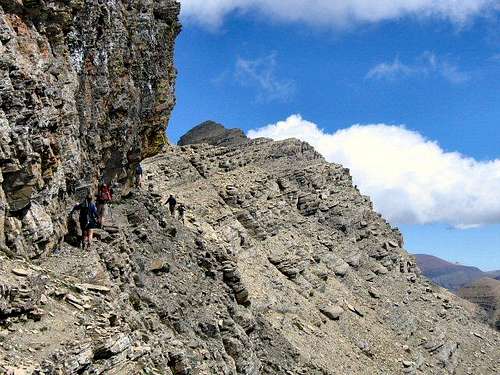
The trail head is exceptionally easy to locate. Simply take Going-to-the-Sun Road to The Loop, which is marked on all maps, and where there are both parking and restroom facilities. The Loop is approximately half way, mileage-wise, across GNP. If coming from West Glacier it is about 25 miles, and if coming from St. Mary—that is, from the east—it is about the same distance, but with the added incentive of crossing the Continental Divide at Logan Pass. The trail is well marked, and takes off at the immediate north end of the sharp turn comprising The Loop, is quite good until approximately a mile past the Granite Park Chalet—at which point, upon reaching the Grinnell Glacier Overlook it becomes a (good) goat trail.
If climbing Grinnell as an eastern approach from the Many Glacier Valley, there are four routes, one of which—that of the Swiftcurrent Glacier Basin—is the subject of the excellent route page Distressbark has posted: From the east, via Swiftcurrent Glacier Basin
In addition to the two above-listed routes now officially attached to the page (see links above, and also sidebar at left), A Climber's Guide to Glacier National Park lists three other means of ascents, all of which approach from the east, via the Many Glacier area. Edwards names these routes as follows: 1) The Grinnell Point Route 2) The South Slope Route 3) The Grinnell Glacier Overlook Route [Edwards also shows a fourth means of ascent, "Swiftcurrent Glacier Basin (and Grinnell Mountain)," which is Distressbark's route.]
Getting ThereStandard Precautionary Note: All GNP roads are closed in winter, with Going-to-the-Sun Road (the major route through the park; its eastern terminus is at Saint Mary) sometimes not opening until July (average opening is second week in June; earliest opening ever is May 16, 1987, with the next earliest being May 22, 2005). Don't head out early in the year (i.e., June/early July) without checking the status of these roads; it is not unusual to have repeated, sometimes lengthy, road closures due to storms, avalanches, rock slides, or all three! The same holds true for late in the year; weather changes dramatically in Glacier, beginning usually around the end of August, with road closures normally becoming more and more frequent throughout the month of September (although don't shy away from going, there can also be very nice—albeit cool or cold—days of Indian Summer throughout this time frame; plus the park is relatively free of people after Labor Day). The following links are pretty much self-explanatory, and provide all sorts of useful information: Map of Waterton/Glacier International Peace Park (Note that clicking on the image after it loads brings up a larger version, making it MUCH easier to read.) And finally, click here for current information, as well as easy access to some interesting photos showing the Plowing of Going-to-the-Sun Road. The Red Tape, Wildlife, & Cautions Section
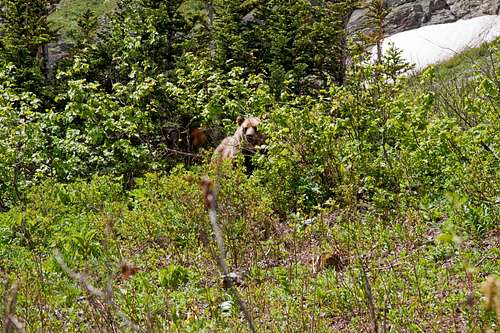
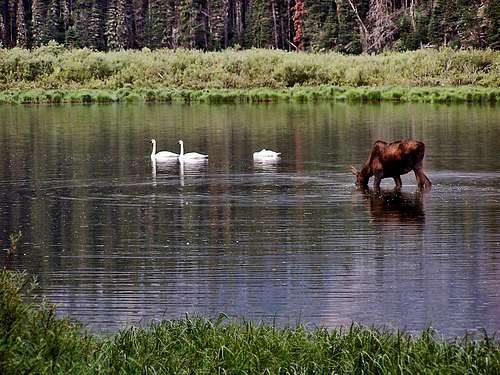
No permits required, but you must pay a park entry fee, which is $25 for one week, or $35 for an annual pass. Registration for day climbs in Glacier National Park is recommended, but not mandatory. Probably anyone prone to climbing in this part of the country already knows this, but the Northern Rockies are full of wildlife. Always be aware, and don't do anything stupid, like—for example—feed the bears, think that a mountain lion is even remotely related to your pet cat, or run up to a moose (moose are quite unpredictable, irritable, and very dangerous). And never, ever, EVER forget you're in grizzly country; they insist on being left alone—disagreement on that point is not an argument you'll win! Bear spray and noise should be part of every GNP foray you make into the back country. Black bears will be found in the forests, grizzlies commonly venture onto the above-timberline tundra, sometimes, when in pursuit of such delicacies as ladybugs or cutworm moth larva, even to the summits! Also note that improperly stored food in park campgrounds (i.e., scraps left around the table or campfire, or edibles in your tent rather than your car) will subject you to a $50 fine. If you wander off, leaving your pack unattended, and there is food in it which attracts the attention of, for example, a bear, it is also a fine. Folks, the Park Service is serious about not providing human food access to the critters!
When To Climb, & Climbing ConsiderationsFrom late June/early July (during this time frame expect LOTS of snow in the high elevations) to early fall, depending on snow conditions. Traditional climbing season in the Northern Rockies is July, August, and September—with September weather becoming progressively colder and more unstable (sometimes dramatically so: PAY ATTENTION!) as the month progresses—but does of course vary from year to year. There are occasional winter climbs in the park, but not often, and then only by well-equipped, area-wise, extremely competent individuals. Basically, most of GNP is inaccessable through the winter, and avalanche danger, to put it mildly, is extreme almost everywhere. CLIMBING CONSIDERATIONS Because of the nature of the rock, there are special considerations regarding climbing in Glacier National Park, and grading systems unique to the Park have been developed by both J. Gordon Edwards and the Glacier Mountaineering Society. Anyone doing more than just "trail" hiking in this part of the Rockies should read the excellent and important information put together by Fred and Moni Spicker. Much—if not most—of the rock in GNP is sedimentary and rotten, and you need to know about it: Glacier National Park Rock & Grading Systems. CampingThere are numerous campgrounds available within Glacier National Park, of which only Fish Creek and Saint Mary take reservations (not required, but probably a good idea during the peak summer tourist period, especially on weekends). There are also many campgrounds as well as motels just outside the park on both the west and east sides. Our route up Mount Grinnell took us by the Granite Park Chalet, which could certainly be used as a base of operations. Interested? Try this link for reservation and pricing information. Click here for General Camping Information, and click here for Current Site Availability in specific campgrounds. Also, for those so inclined...GNP does have Backcountry Campsites throughout the park. Some of these sites can be reserved; others are on a first come basis. Anyone doing extensive, several day, remote hiking/climbing would be well advised to check this out. Current Park Conditions/Web CamsWeather page—an overview, plus current conditions and forecast This is the New NPS Web Cam Page.
External Links/Additional Information/Items of Related Interest
In TributeOn March 1, 2011, Vernon Garner, Saintgrizzly, left us after losing a bold, inspiring fight against pancreatic cancer. Or maybe he won, for he is at last free of his pain and has "shuffle[d] off this mortal coil." Vernon was an important contributor on SummitPost, but beyond merely making good, informative pages, he actually inspired many who read his work. No one put more work into his or her pages than Vernon did, and many of those pages, especially those related to Glacier National Park, the place he loved above all others, are works of art in both the writing and layout. More than one person has wanted to visit Glacier or go back to Glacier largely due to what he shared about that magnificent place. Many people on SP counted Vernon among their friends, and many more saw him as one of the best, one of those who exemplified the spirit of this site. He was one of the best of us, he will be missed, and he will not be forgotten. As a tribute to him, Vernon's pages will remain in his name. Any member who sees a need for an addition or correction should please contact site management via the "Send PM to the Elves" feature. Rest well and climb on, Vernon. |





 2 Routes