

-
 13888 Hits
-
 80.49% Score
-
 12 Votes
 Page Type:
|
Mountain/Rock |
|---|---|
 Lat/Lon:
|
38.99370°N / 77.2499°W |
 Activities:
|
Trad Climbing, Toprope, Scrambling |
 Season:
|
Spring, Summer, Fall, Winter |
 Elevation:
|
137 ft / 42 m |

|
Overview

Sand Castles

Sand Box Corner
A compact area with a handful of easy to moderate climbs from 5.2 to 5.7, the Sandbox is excellent for beginners and scramblers, which also helps explain why it is a popular spot for climbing classes to meet and learn. The routes are from 25 to 45 feet in vertical gain, which means that energetic climbers can do most or all of them in one day. Because of this spot’s popularity with classes and beginners, I strongly recommend climbing on weekday afternoons or arriving very early on weekends. Weekday afternoons are great in general for climbing on the Virginia side of Great Falls; there usually are not many other climbers, and the routes are shaded, which is very nice during the warm, humid months from May through September.
Under normal and low-water conditions, the Sandbox is set well back from the dangerous Potomac River and lives up to its name; the area between it and the river consists of a mix of deep sand and small shells, making it possibly the best place to fall in the entire Great Falls area if one is leading or free soloing the routes. Another nice thing about the Sandbox, especially for scramblers and for newcomers to roped climbing, is that some of the routes are, in my opinion, on the easier end of their ratings. For example, the 5.4 Sand Box Corner here, a great and popular route for beginners, is much easier than the 5.4 Layback Dihedral and Pride routes not far downstream. And Sand Box Crack, rated 5.6, is one I did unroped with no trouble.
Because the crag is set well back from the river, it is accessible almost all the time, even when the bases of many other crags here are under water.
The named routes at the Sandbox, as you face it from the river, are, from left to right (downstream to upstream end), as follows (ones I have climbed are in bold):
• Box Left (5.2)-- a fine introduction to the Sandbox crag. The route climbs a large, prominent crack that in places is a bit dirty but which has plenty of good places for the hands and feet while serving up enough exposure to get some adrenaline going. I honestly think this route is too easy for roping up, but that’s always an individual call, and even the best free soloist is as mortal as the rest of us when s/he takes a fall. The climb is only about 30 vertical feet, another reason it makes more sense for unroped climbing than roped. It is a ladder-like route; to make it a little harder, exit right rather than along the natural lines straight up and left. This route is leadable and takes gear both large and small; you can protect the off-width with #5 and #6 Camalots, but cams aren't trustworthy in the rock here. Photos in this page's gallery illustrate the conditions and will help with locating this particular route.
• Sand Box Crack (5.6)-- about 40’ of vertical climbing, but the route is longer than that due to its diagonal path. In my own opinion, it is an easier 5.6 than several 5.3-5.5 routes I have climbed in Great Falls Park, but it deserves to be taken seriously since the exposure on it means that an unprotected fall will always result in a little trip all the way to the bottom. Therefore, despite the fact that I have climbed this route unroped, I strongly recommend using the safety of a rope. On a rope, whether toprope or trad climbing, be aware that the diagonal nature of the route likely may cause a pendulum into Sand Box Corner and the adjacent wall if you take a fall, so wear your helmet and don't climb this one if someone is on Sand Box Corner. This route is leadable with hexes and stoppers.
• Variation (5.11)-- the face between Sand Box Crack and Sand Box Corner. It has a few tough moves and one very hard one. Not steep, but balancey. A nice, non-intimidating 11 for someone breaking into the grade.
• Sand Box Corner (5.4)-- classic area route. If you’re toproping, as most technical climbers at Great Falls do, there’s little to say but “Have fun.” If, however, you’re after the thrill of climbing with no protection but your limbs and instincts, just know that although you’re looking at an ugly fall once you get about a third of the way up, all you need are a clear head and some patience to reach about and find the holds and foot placements that will work for you. Climbing this route roped strikes me as a rather uninteresting undertaking unless you're completely new to Class 5 climbs (my son cruised up this route his first time climbing it at 7 and has no more interest in it because he thinks it's too easy), but going without that protection will narrow your focus, grab your attention, and make you feel that you really do deserve that cold beer waiting for you in the cooler back at the car (of course, alcoholic beverages are banned within the park, but we’ll just pretend I didn’t mention that). Another nice thing about this route is that it is suitable for leading; it loves passive pro and is great for practicing or learning to climb with stoppers (it will take some smaller cams, too, but cams aren't trustworthy in the rock here).
• The Pox (5.7)-- the face just right of Sand Box Corner.
• Sand Castles (5.6)-- arête route. Tricky, fun start, and cool exposure the rest of the way. A pretty solid 5.6.
• Right Dihedral (5.3)-- a short (35 vertical feet) but fun scrambling route, and also good for roped beginners. Climbing this and Sand Box Corner gives a nice taste for the better things that await a few minutes downstream at Dihedrals. The rock can be a little slippery, and the start of this climb, which requires negotiating a small, short overhang, is the hardest part and is tougher than anything on Sand Box Corner unless you're tall and know where the key holds are. The rest is easy. This route leads well.
• Lifestyles (5.3)--This route is only 25 feet and feels more like a bouldering problem than a climb. Just climb the “scoops” to the right of Right Dihedral and exit to the left.
• Variation (5.8)-- Exit right through the overhang above the top “scoop.”
By far, the most common climbing style at Great Falls is toproping. Leading is possible, but local customs and regulations dictate the use of only natural gear; that and the smooth nature of the rock here often make leading difficult on Great Falls routes.
By far, the most common climbing style at Great Falls is toproping. Leading is possible, but local customs and regulations dictate the use of only natural gear; that and the smooth nature of the rock here often make leading difficult on Great Falls routes.
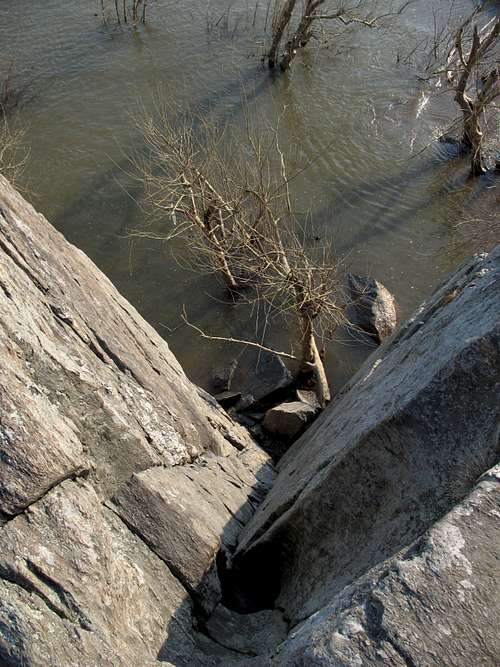
Flood conditions at Sand Box Corner (5.4), a popular route here
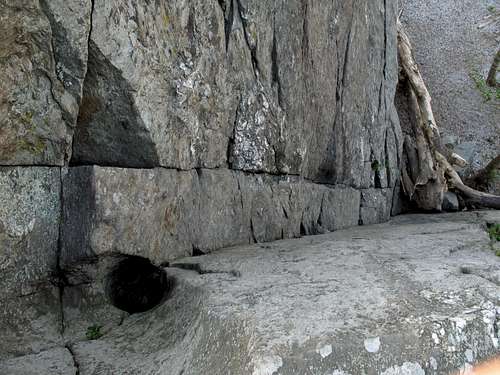 From above Sand Box Corner
Getting There
From the western part of I-495, a piece of the Capital Beltway, take Exit 44 for Route 193, Georgetown Pike; this is the second exit south of the Maryland border. Drive west for a few miles until you see the well-signed road leading to Great Falls Park. Turn right and follow the road about a mile to the entrance station. After passing the entrance station, make an immediate right and drive down to a parking area. This is the area used by most climbers and kayakers.To reach the crag, hike toward the river for two or three minutes and then turn right on the River Trail. In about five minutes, probably less, you will see some cliffs and outcrops; this is the top of the Sandbox and is just past a large boulder and semi-permanent puddle/pond that are on the right side of the trail; it is also just after the end of a new-looking fence. NOTE: your guidebook may mention a sign indicating access to the Sandbox area; as of November 2012, that sign was no longer there.
Hike the use trail that heads for the top of the crag. Then scramble (Class 3) to the base.
Red Tape
The park is open from 7 A.M. until dark every day except Christmas. There is an admission fee, good for three days, of $10 per vehicle. Annual and interagency passes are also available (the latter costs $80).Climbers are asked to register (free). There is a registration box at the climbers’ parking area, and there is also one at the visitor center.
Altering the rock to place gear is prohibited. Do not remove or replace existing bolts. The general rule here is that if you can't lead using natural gear, you should toprope just as most others do.
The area is popular and can be quite crowded, especially on weekends spring through fall. Expect spectators. Also, some of the climbers here, skilled as they may be, are less the sanctity-of-nature types and more the types who see mountains and crags as a climbing gym with cool views. Don’t be surprised to see a climber smoking a cigarette or yakking on a cell phone about his new BMW or his stock portfolio as he waits his turn; don't be surprised to see obvious gym climbers blaring bad music. So if you prefer a little communion with your climbing, try going on a weekday or in winter (but be aware that mornings, when the Virginia side of the Great Falls area gets plenty of sun, are often in the 20s F or lower in winter, not great for climbing).
The park is home to copperheads. It’s unlikely that they hang out in holds on the cliffs themselves, but be aware. The danger, though slim, is greatest near the clifftops, where there are more places for snakes to be.
Poison ivy is abundant. The humid period from late spring through early fall features gnats, mosquitoes, and other biting insects.
Camping
NoneExternal Links
Great Falls NPS siteA good resource for the area is Eric Horst’s Rock Climbing Virginia, West Virginia, and Maryland. The section on Great Falls provides one-sentence overviews of the routes. There are also photos, taken either from a boat or from the Maryland side, of the crags, and the photos have useful diagrams showing the locations and directions of the routes. The guide leaves the step-by-step concerns, and the fun, to you.
An even better resource is the PATC Climbers' Guide, which focuses just on the Great Falls area. It lists more crags and routes than the other guide does, and the photos are usually better in terms of helpfulness with finding the routes.