


 Page Type:
|
Mountain/Rock |
|---|---|
 Lat/Lon:
|
42.10403°N / 118.70744°W |
 County:
|
Lake |
 Activities:
|
Hiking, Mountaineering, Scrambling |
 Season:
|
Spring, Summer, Fall, Winter |
|
Elevation:
|
8420 ft / 2566 m |

|
West Pueblo Ridge
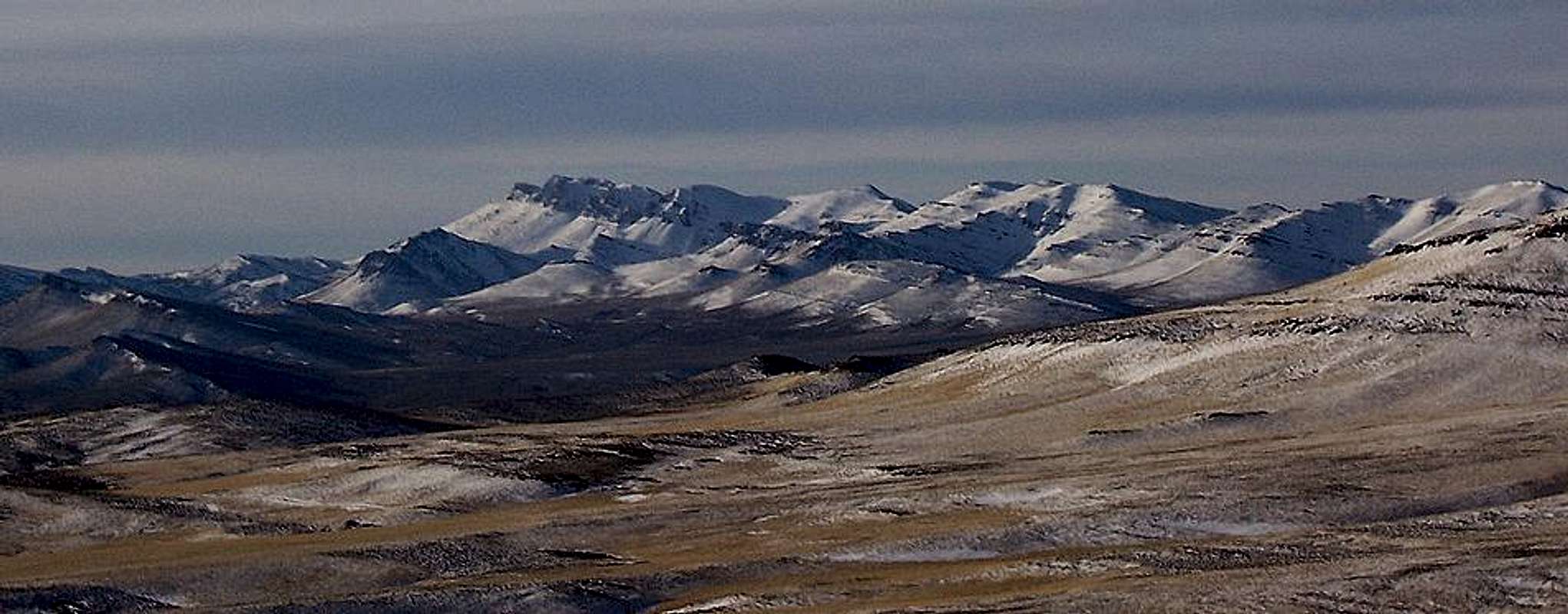
Hidden amidst the desolate Pueblo Mountains of Southeast Oregon is one of the true high elevation gems of this harsh region. The West Pueblo Ridge is the dramatically westward tilted escarpment that comprises the bulk of the Pueblo Mountain Range. At 8420 feet, this is the second highest point in the range, one of the hundred highest summits in Oregon, and the fourth highest point in Southeast Oregon with more than 1500 feet of prominence. The mountain offers an easy dayhike with 3rd class scramble approaches from the east, and 2nd class ridge walk approaches from the west. The Desert Trail Association offers a trail guide to the lightly marked route that traverses the range from south to north and travels along the West Pueblo Ridge.Much of the Pueblo Mountain Range is the same Steens Basalt that blankets most of Southeast Oregon, however there is also large amounts of much older metamorphic rock underlying the geologically more recent basalt that is evident along the east facing escarpment and as pinnacles cutting from ridgelines. The Pueblo Range is a relatively small fault tilt when compared to massive tilts such as Steens Mountain and Abert Rim, but it has tilted to a much greater degree than these other nearby ranges, which accounts for its 8000+ elevations. Evidence of the angle of tilt can be seen along ridges on the west face of the range and by the angle of the rimrock in the image below.
Below, the West Pueblo Ridge seen from Long Hollow Pass
Like other Oregon Basin and Range peaks, expect bunchgrasses and sagebrush on the slopes, with alder, cottonwood, and willows along the stream-bottoms. The book "Oregon Desert Guide" states that Juniper is a rare occurrence here with less than 10 trees sighted in the range. Sharp-eyed hikers may spot one along the Stonehouse-Modesto Ridge route. Antelope are very common here, especially in meadows along the east face, and Bighorn Sheep can also be found in this range although are seen infrequently.
Views from the summit include Eagle Peak in the Warner Mountains of California to the distant southeast; Duffer Peak dominates the southern view; Steens Mountain's massive bulk eclipses the view north; and Pueblo Mountain obscures much of the view east, although Orevada View in the Trout Creek Range is visible. Visible in the west is Beatys Butte, Hart Mountain, and Drake Peak.
Getting There
The West Pueblo Ridge can be accessed from either the west or east, both choices will result in several miles of travel up very rough 4x4 roads with stream crossings. Seen from Pueblo Mountain
FROM THE EAST: Dennis Poulin provided a route page for the
Ten Cent Meadow Route; this will take you past the northern base of Pueblo Mountain, to the eastern foot of West Pueblo Ridge. Additionally; route directions can be found in Barbara Bond's 75 Scrambles In Oregon. Both east approaches use the same Arizona Creek 4x4 road that is followed for summiting Pueblo Mountain Proper. Both mountains could be summited in a single long day from a base camp in either Stergen Meadows at the head of Arizona Creek or Ten Cent Meadows further south in the basin between Pueblo and West Pueblo Mountains. From Stergen Meadows it is roughly 3 miles one way with 2100 feet of elevation gain.
FROM THE WEST: This is the Stonehouse-Modesto Route. To access this one, you will need to find Stonehouse Creek in the Upper Bog Hot Valley near the Oregon End Ranch. To reach Stonehouse Creek turn onto the gravel Bog Hot road where highway 140 circles south of the Pueblo Mountain Range in Nevada, this is 9 miles west of Denio Junction. Once on the Bog Hot road travel 10 miles north past the Bog Hot Reservoir and Hot Springs to a 90 degree turn to the east at the Oregon End Ranch. Continue around the corner where it will almost immediately turn back north. After another 2.5 miles of northward travel the road will sweep west down into the Oregon End Ranch. At this point you will instead continue northeast on a slightly worse quality dirt road. Within half a mile you will see a road take off to the east, turn right here. Immediately you will come to another Y in the road, here take a left. From this point there are no further options to turn right or left. It's a rough 3 miles to the end of the road with two gates you will have to open and close, and at least two stream crossings (possibly more depending on conditions). Follow the road as far as you are comfortable with, there is clearing in the sagebrush at 3 miles in next to a creek that is the ideal starting point for hiking the ridge. The first major stream crossing is at 2 miles, and would also be a possible camping location. From the roads end along Stonehouse Creek it is a 3 mile scramble one way with 2800 feet of elevation gain. Oregon Topozone maps come in real handy for navigating the dirt track roads out here, but the terrain is wide open so finding the route is not very difficult.
Red Tape
 Summit Rib
Burns BLM: (541) 573-4400
Always have at least one spare tire when traveling in the Pueblo Mountains, all roads are in poor condition and the nearest tire repairs can be done is over 100 miles away in either Burns or Winnemucca.
Camping
 summit escarpment
External Links & Weather
Burns BLM page75 Scrambles In Oregon.
Oregon Desert Guide


Subpeaks of the West Pueblo Ridge
The 8000 foot crest of the West Pueblo Ridge runs two and a half miles from the Willow Creek Summits in the north to Peak 8110 in the south. This is the true alpine region of the Pueblo Mountains, and provides a dividing wall between the Bog Hot / Oregon End Basin and the meadows laying at the western foot of 8600 foot Pueblo Mountain. Only game trails exist in the Pueblos, and Bighorn Sheep can be found along this ridgeline.West Pueblo Ridge reference map
Below, the entirety of the 8000 foot crest of West Pueblo Ridge seen from south of the Oregon End Ranch

Willow Creek Pockets - In the image below the peak at right exceeds 8000 feet and is found above the Willow Creek Pockets on the north end of the West Pueblo Ridge. The mountain at left is 7878 feet and lies a short distance to the north of the West Pueblo Ridge. Each could be accessed from either of the approach routes for the West Pueblo Ridge with a moderate ridge traverse. The South Fork of Willow Creek drains from the Willow Creek Pockets, a 6000 foot basin laying below these two points that according to maps does have primitive road access.
 Peaks north of the West Pueblo Ridge
Peak 8110
This is the highest point along the West Pueblo Ridge south of the primary summit. Little Stonehouse Creek springs from the western basin of 8110 and Ten Cent Meadows lies below the eastern face. Peak 8110 is most easily accessed from the Ten Cent Meadow Route.
 Peak 8110
Other Summits of the Pueblo Mountain Range
 Fields BM - Located due west of the town of Fields is this 6537 foot peak on the north end of the Pueblo Range. Fields BM is the closest significant peak to the town of Fields, and appears to have transmitter towers atop its summit. If desiring to summit this northernmost point in the Pueblos, most likely best access would be from Long Hollow Pass on Highway 205.
 Unnamed Butte - At 5753 feet this distinctively red mountain rises over 1500 feet from the valley floor and is the first distinctive summit along the south end of the Pueblo Range. Picture taken near Baltazor Hot Spring north of Continental Lake.
 South Pueblo Ridge - The west shore of Continental Lake rises 800 feet revealing this multihued east facing cliff.
 Pueblo Mountains Nevada Highpoint - The leftmost point on the ridgeline here is the highest point in the Pueblos south of the Oregon Border. Elevation - 6433 feet. Seen from Denio Junction area.
 North Pueblo Ridge - The highpoints of this sawtooth ridgeline are slightly over 7000 feet of elevation. The Pueblo Traverse Trail (Desert Trail) runs the length of this ridgline.
 Cold Spring / Rough Canyon Peak - At 7878 feet this broad flanked peak is found 2.2 miles NNW of the West Pueblo Ridge Highpoint. This picture taken near the Oregon End Ranch.
 Unnamed Butte 7418 - Looking east up Stonehouse Creek towards a butte on the west side of the Pueblo Mountains
 2 Routes