


 Page Type:
|
Area/Range |
|---|---|
 Lat/Lon:
|
31.07525°N / 7.96235°W |
 Activities:
|
Hiking, Mountaineering, Ice Climbing, Mixed, Scrambling |
 Season:
|
Spring, Summer, Fall, Winter |
 Elevation:
|
13671 ft / 4167 m |

|
|
|

|
Overview
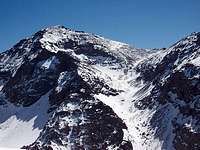
 North Face of Tazaghart
It is the most frequented area by mountaineers and skiers, which does mean that it has the most developed infrastructure to support mountain trips. However, it also has the most 'issues' too - large mule supported expeditions of tourists tending to beat the same trails leading to significant erosion and some irresponsible dumping of litter.
The different seasons show off the different characters of these mountains. The hot dry summers will test your endurance, then sometimes just as you the day draws to end the sting in the tail are massive thunderstorms guaranteed to spoil your day. Autumn eventually leads to the first dustings of snow and often some very low temperatures. Winter gives us the classic alpine views with snow casting it's gentle touch to the harshness of the previous seasons. Spring is when the Atlas come alive, retreating snow giving way to new shoots and wildlife.
History
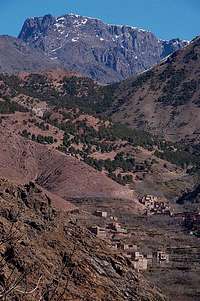
 Upper Toubkal Valley
The Marquis was a remarkable man, an officer in the French army, and like many explorers had a deep attraction to 'dangerous expeditions'. His first trip to Morocco started at Mogador (Essouira) on the 24th December 1904, before the days of the French 'Protectorate'. His party (Algerians & Moroccans) travelled disguised as a group from Sudan seemingly planning to visit the various holy landmarks of the area. Eventually captured, he pretended to be an ignorant inhabitant of Tripoli with no idea about 'scientific' equipment. He was trapped into admiting some knowledge of medical matters eventually being presented with a patient clearly dying of gangrene. Morphine seemed to be the miracle cure which earned him incredible respect.
Following the French 'occupation' of Morocco he spent much time wandering the Atlas Mountains charting the mineral wealth. Alongside this he indulged in his passion for mountain climbing, with the ascent of Toubkal being his best known first ascent.
Alongside the Marquis were a small group of mountaineers that opened up much of the area to the domain of European climbers. Louis Léon Charles Neltner, a gelogist, spent over 20 years exploring the High Atlas area. He is best known for being the geologist on the first ever French trip to the Karakoram. Jacques de Lépiney was the next best known individual to open up the Atlas. Somewhat more of a 'specialist' than Neltner, they both had the honour of having the first huts named after them. The Neltner hut built in 1938.
Following the initial flurry of development by these remarkable indivduals it has become harder to trace any meaningful developments until Michel Peyron's Grand Traverse du Atlas Marocaine. The original book came with a preface in English, the actual route descriptions in French. This 'Guide book' was produced after years of exploration by the author. He is still lecturing in France and Morocco, and has a deep understanding of the Moroccan culture, his speciality is in Amazighia (the Berber language.)
With the opening up of commercial tour operators, the Atlas mountains has become increasingly popular. Trains of mules carrying huge loads for western tourists regularly ply the main trails in the area. Consequently, it has lost some of it's charm and mystic. Morocco is also struggling to deal with the present realities of overgrazing, over population and deforestation. On top of this the large tour operators are somewhat less responsible in their management of waste. As a result some areas have, unfortunately, become quite unsightly.
Trailheads
Imlil is the best known, 70 kms SSE from Marrakech along the road to Touradant via the Tizi-n-Test pass. It is a windy tarmaced road. If you are driving head for Tahanout, Asni then branch left for the Toubkal National Park / Imlil. There are most basic provisions here, and it is possible to hire some mountaineering equipment. There are a number of huts / auberges if you wish to stay (see www.imlil.org for more details)If you are planning on using public transport the best option is to club together and hire a whole taxi. You can find the Tahanout / Asni taxis at Sherij AlBeger (Cow's pool, don't ask me why.)
Ijoukak is further up the Tizi-n-Test. The drive there along the Oued Nfis (River Nfis) is stunning. Ijoukak and neighbouring Telat-n-Yacoub is not at all set up for supporting mountaineering trips, however, the route in to the Toubkal Massif is a wonderful walk in isolated valley systems.
Oukaimeden is the best known ski resort in Morocco. If driving from Marrakech head towards the Ourika valley. Go past the Tnine Ourika junction, head up the main valley. Just before Aghbalou turn right, and follow this road all the way to the ski station. In the skiing season you will need to pay 10dhs to gain entrance. The Ourika / Setti Fatma (at the end of the Ourika tarmac road) taxis leave from the Sherij ElBeger taxi station too. There are some great peaks to climb around here, and some nice treks into surrounding valley systems. For those that are up to doing the Toubkal ring, this is the starting point. Although this is a ski resort, there are not a lot of facilities for the independent mountaineer / skier. Best to arrive having stocked up in Marrakech.
Lac D'Ifni is a lot harder to get to, and not a feasible option if you want to leave a car. It is a significant distance from Marrakech (a day's drive)with a good bit of rough track. The route in from here to the Toubkal Massif is a long haul up to the Tizi-n-Ouanoums. If you can persuade someone to drop you here - it is certainly worth the effort.
Main Peaks

Adrar-n-Oukaimeden 3273 m
Angour 3616m
Adrar-n-Ineghmar 3892m
Bou Iguenouane 3882m
Aksoual 3842m
Azrou n Tamadot 3664m
Tichki 3753m
Adrar Tinilim (East of previous peak)
Afekhoui 3755m
Toubkal 4617m
Amrourough 3280m (East of previous peak)
Timesguida-n-Ouanoukrim 4088m
Ras-n-Ouanoukrim 4083m
Akioud 4030m
Afella-n-Ouanoukrim 4043m
Biguinoussene 4002m
Tazaghart 3843m (West of previous peak)
Tadat (Not strictly a mountain, but a great tower for rock routes)
Aguelzim 3547m
Adrar Adj 3129m
More descriptions to follow
External Links
Information about Imlil accommodation and climbing ToubkalOukaimeden Weather Forecast
High Atlas Weather Blog
 1 Areas & Ranges
dmiki - Mar 25, 2008 3:37 pm - Hasn't voted
another possible weather linkMoroccan High Atlas Mountains & Mount Toubkal News - Weather http://nomadicmorocco.blogspot.com/search/label/Weather%20%2F%20Snow
MattHC - Mar 31, 2008 9:13 am - Hasn't voted
Re: another possible weather linkHi dmiki! Thanks for that - yeh that blog is run by a good mate of mine Des. I didn't put the link up as it doesn't give forecasts, however, it does another job of telling us what has fallen in the area. I'll stick in the page, thanks again. Matt
relatko - Sep 22, 2011 2:03 pm - Hasn't voted
Lac'd IfniThere are very little informations on the web about the transportation in the south side of Central High Atlas, even google maps are very confusing (home people had no idea about towns on the map) so this is what we found out at the place: To get there you can first go to Agouim (bus or grand taxi). From Agouim you can either hire a terrain car directly to Lac d'Ifni (mere expensive) ore drive by grand taxi to Tidili. Grand taxis cannot go further. From there on locals drive on terrain cars (quite frequently) so you can get a lift to a village below Ifni - Mezguemnat. There is a hostel there. New road is being built in the area, however it will probably be too steep in parts for grand taxis.
rgg - Mar 30, 2012 2:16 am - Hasn't voted
Western, not CentralI believe that this is the Western High Atlas, not the Central.
MattHC - Mar 30, 2012 4:45 am - Hasn't voted
Re: Western, not CentralHi, it is the Central High Atlas area. The Western High Atlas are the group of mountains stretching (roughly) west of the tizi-n-Test pass towards agadir. The heart of the Western High Atlas is the Tichka Plateau, with notable and remote peaks in the area.
rgg - Mar 30, 2012 7:07 am - Hasn't voted
Re: Western, not CentralI thought that the Central High Atlas was the area around M'Goun? I've visited only once so I'm far away from being an expert on Moroccan mountains, but here is a link with extensive info, including descriptions of the Western, Central and Eastern High Atlas. I found several similar descriptions. Are you saying this is wrong? Mind you, I also found one reference (Mountaineering in the Moroccan High Atlas, by Des Clark) that does indeed say that the area west of Tizi N'Test is sometimes called the Western High Atlas - but I did not read anywhere that the area around Toubkal was the Central High Atlas.