

-
 16976 Hits
-
 97.89% Score
-
 74 Votes
 Page Type:
|
Area/Range |
|---|---|
 Activities:
|
Trad Climbing, Sport Climbing, Toprope |
 Season:
|
Spring, Summer, Fall |
 Elevation:
|
6500 ft / 1981 m |

|
Overview

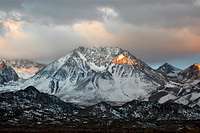
Basin Mountain Kissed By The Sun

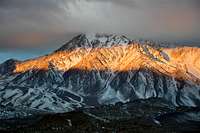
Band of Gold Across Mount Tom.
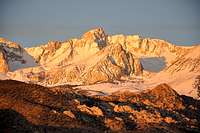
Mount Humphreys

Mount Emerson

Clearing Storm on Basin Mountain
During the past several months I have been producing separate pages on different crags in The Buttermilks region of The Eastern Sierras. The purpose of this “Area” page is to have a more integrated sense for the scope and dimension of the area and what it has to offer to a visitor. Needless to mention, this page will not cover all of the crags in The Buttermilks, but the most popular ones. I have left plenty of room for future submissions by myself or other Summit Post members.
With its international reputation, The Buttermilks, affectionately known as “The Milks,” is known for its countless boulders and bouldering test pieces. Generally speaking, the sport of bouldering, as an off shoot of rock climbing, has gone through an evolutionary change in the past twenty years. Walking around The Buttermilks boulders, you quickly realize that many climbers have travelled for thousands of miles and from all corners of the earth to test themselves against the boulders here. If you arrive during the morning hours, you will see climbers with their crash pads strapped on quickly walking to their warm-up boulders. Soon after, the base of the boulders will be covered with crash pads, chalk bags and extra climbing shoes. Watching all this makes me turn green in envy and regret that in the old times we had to jump down on whatever we had at the base from rocks to hard dirt and, if we were lucky, sand. But, dirt always came in handy for our sweaty hands. It was John Gill, the iconic boulderer of the sixties who introduced the use of gymanstics chalk to the sport of bouldering.


History shows that bouldering areas have become popular only to fall from grace after a number of years. The case with the Buttermilks boulders has been exactly the opposite. These boulders went with limited attention for decades. Then some of the best climbers in America decided to make Bishop, Mammoth Lakes, and the nearby towns their home. It was during this period that I noticed an explosion in the activity around these boulders. During the 1980s, I never saw more than seven or eight cars parked in the parking areas. Today, you can count several dozen cars parked in the parking areas and along the dirt road on any given weekend during the climbing seasons.
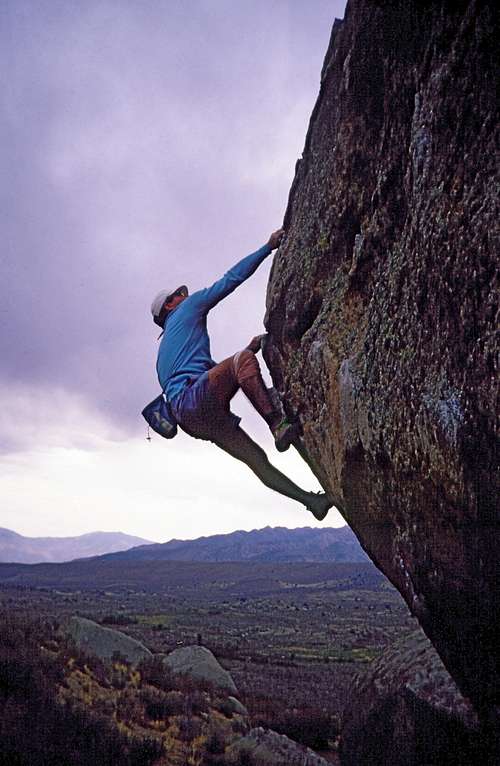
Sierra Nevada Range, Mid 90s
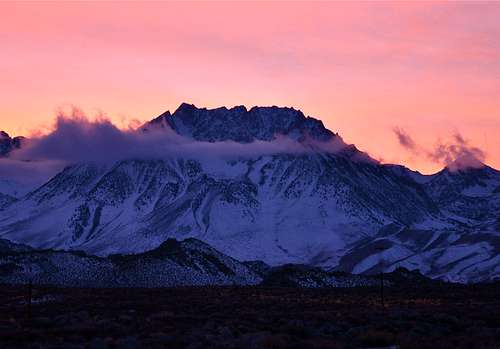
Basin Mountain at Dusk
What makes The Buttermilks special is not only the boulders but much larger rock formations such as Skin Diver, The Owl, Windy Wall, Wrangler Rock,Y-Boulder,The Slab,Wavelength. In addition to all the above rock formations, The Buttermilks offers some of the most majestic views of the eastern Sierras. From here, you get the best views of Mount Tom, Basin Mountain, Mount Humphreys and Mount Emerson. It is common knowledge that the higher you are the greater the view of the mountains, and most of these formations are located near or at the very top of the hill from the vast boulder fields of The Buttermilks. One of my favorite places in the Buttermilks is a secluded narrow corridor known as “Picnic Valley.” This charming valley, by its very nature, produces the best natural frame for the surrounding mountains and the Buttermilks valley. As you make the approach to The Picnic Valley the first formation you come to is The Owl. The Owl sits, like a watch dog, or watch owl in this case, at the entrance to this narrow corridor. Inside of the Picnic Valley, you are surrounded by other notable formations such as South Mount Klieforth and The Slab. Another notable and secluded corridor with breath-taking views of the Sierras is where Windy Wall is located. Take your time and breathe in the fresh mountain air from this beautiful area.
 Jeremy Bonder sending Evilution Direct, V11
The Slab
The Slab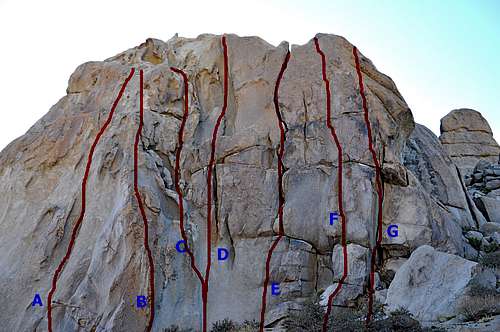
east face

SW face
There are also a number of climbs on the south west face of The Slab formation. In contrast with the east face, the south west face is steep and convoluted. To get to this side of the formation, you need to hike up a steep and sandy, but short, gully on the left side of the east face. When you get to the top of this narrow gully and out of the Picnic Valley, the Sierras will open up in front of you. It will be hard to decide if you should climb or just enjoy the view. Most people do both.
Climbs of The Slab, The Buttermilks | |
| A | Got Yo Sequence Hanging, 10c, 3 bolts, Standard rck |
| B | The Slab Direct, 5.9, 1 bolt, standard rack |
| C | Totally Slabular, no rating offered |
| D | Bury My Heart, 11a, 2 bolts, and standard rack |
| E | Robin's Crack, 10a, and standard rack |
| F | Macho Homo, 5.9, 1 bolt, and standard rack |
| G | Stress Man, 10d, bolts and and standard rack |
| H | Marlboro Man, 10d, wide crack, pro to 6 inches |
| I | Cat Fight, no rating offered |
| J | No Fat Chicks, 10a, pro to 3.5 inches |
| K | Great Buttermilks Crack, 11c, pro to 2.5 inches |
| L | Bear Fight, 10a, standard rack, pro to 4.5 inches |
| M | Sharp's Scenic Stroll, 5.7, standard rack, pro to 3 inches |
The Owl
The Owl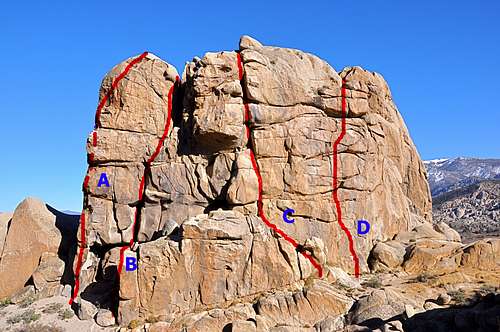
West Face of The Owl

South Face of The Owl
There are two faces with well established routes dating back to the seventies. As you approach The Owl via the “Frontside” parking and The Buttermilks hill, the first view of The Owl is a steep and well-featured face. This is the south face. Getting to the base of the climbs, however, is neither easy nor straight forward. The best approach seems to be from the right, east side, by going down and around several large boulders and hiking back up to the base of the south face.
The approach to the base of the west face, however, is by far easier. As you enter the Picnic Valley the west face of The Owl is immediately to your right. The west face is steep and well featured. Both the south face and the west face of The Owl offer potential for more routes. If you have first hand knowledge of such newer routes please let me know.
| A | Jensen-Strassman, 10c, Standard rack, 3 bolts |
| B | Brown Helmet, 5.9, Crack, standard rack up to 4 inches |
| C | Extreme Levine Meets Godzilla, 10b, standard rack up to 4 inches |
| D | Vertical Smiles, 10c, standard rack up to 4 inches |
| E | Way Cool Tanks, 11a, run-out face, 5 bolts |
| F | Armadillo Crack, 5.8, standard rack up to 4 inches |
| G | Regular Route, 5.5, standard rack up to 4 inches |
Wrangler Rock
Wrangler Rock
There are four documented climbs on Wrangler Rock ranging from 5.6 to 10a. But when you get to the base and see all the features and possibilities you want to go back and get your bolt kit.
| Climbs of Wrangler Rock | |
| A | Lisa's Crack, 5.8 |
| B | The Spittoon, 5.6 |
| C | Buttermilks Pancakes, 5.9 |
| D | Granola, 10a |
| D1 | Not sure, but according to the guide book, also Granola, 10a |
Wrangler Rock like all other rock formation in the Buttermilks is granite and very similar to Joshua Tree rock. The surface of the rock, however, is much rougher. Most new areas and routes need to be cleaned of loose grainy surfaces. Care should be taken on routes that don’t get much traffic. Make sure to tape your hand for climbing any of the cracks, and you will be in for a lot of fun. Enjoy.
Windy Wall, left side
Windy Wall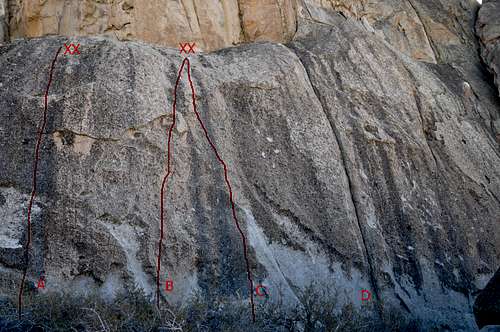
Windy Wall can be divided into two sections, east side and west side. The extreme left starts with a pillar with huecos running from bottom to top. There is a bolted climb on this formation called “Make It Sueded, 10c.”
There are three short bolted face climbs to the left of a hand crack on the east face. The crack is one of the oldest established climbs on the formation and it’s called “Scoot, 5.8.” There is potential for several more climbs on the east wall.
Windy Wall, right side
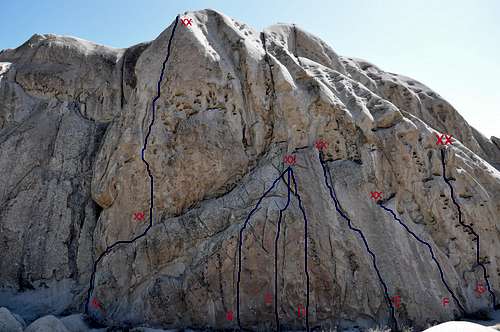
The west wall possesses many more features compared to the east wall. There are a number of cracks from finger size to hand size. There are also well featured face climbs on the west side. Being generally steeper than the east wall, the climbs here are of a higher degree of difficulty.
On the upper tier of the west wall you will see a set of huecos running from bottom to the top of the formation. There is a bolted climb here called “Huecos Thanks, 5.9.” a play on the the name of the famous bouldering area in Texas called “Hueco Tanks.” In addtion, there are a number of classic climbs on the west wall such as “Wild Garlic, 10c” a finger and hand crack and “Rubber Gloves and Razor Blades, 10d” a thin crack. There are also a number of newer bolted face climbs all leading to double bolt anchors.
On the far right side of the west wall you will find a classic “Must Do” climb called “Miles from Nowhere.” “Miles from Nowhere” is a 5.9 climb following a set of bolted huecos, some large enough to sit in, to a double bolted anchor. There is a bit of a runout near the top, but with some creative protection up to an inch you can climb with confidence.
Climbs of Windy Wall, left side | |
| A | Beginner's Route, 5.5 |
| B | Hoot, 5.8 |
| C | poot, 5.9 |
| D | Scoot, 5.8, crack, standard rack, pro to 2 inches |
| Climbs of the right side | |
| A | Hueco Thanks, 5.9 |
| B | Wild Garlic, 10c, crack |
| C | Rubber Gloves And Razor Blades, 10d, crack |
| D | Clean Sweep, 10d |
| E | Dr. Zyme, 10a crack |
| F | Cayenne Pepper, 5.8 |
| G | Miles From Nowhere, 5.9 |
Skin Diver
Skin Diver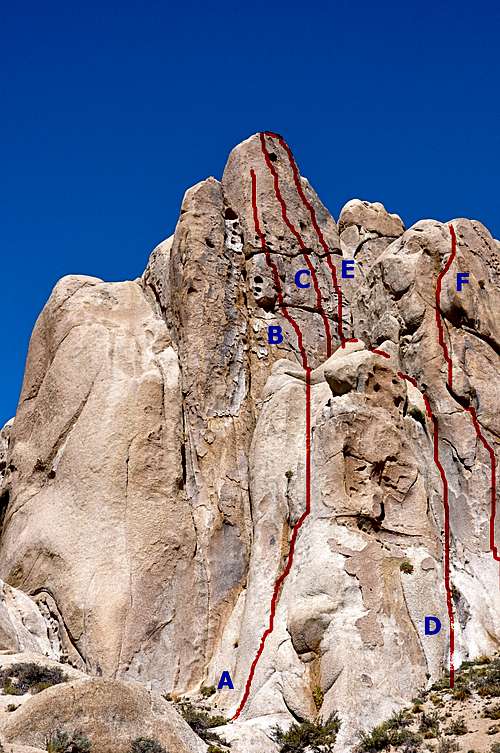
Skin Diver offers climbs ranging from a 5.7 chimney to a 10d bolted face climb. The rock is rough textured granite. Your feet will be happy sticking to the rock, but your hands will cry for some kind of covering such as climbing tape. If you have climbed in Joshua Tree, expect the rock to be more punishing on your skin here. Skin Diver is southeast facing and in the sun most of the day, hence an ideal formation to climb on during the cooler seasons.
| A | Beach Party, 10a, 6 bolts, gear to 3.5" |
| B | Quit While You're Ahead, 10b, 6 bolts, gear to 3.5 |
| C | Freedom of Choice, 10d, bolts and gear |
| D | Approach Chimney, 5.7 Runout |
| E | My Beach, My Wave, 10b, crack, gear to 3.5" |
| F | Weekend Warrior, 10a, bolts and gear to 3.5" |

Wavelength
Wavelength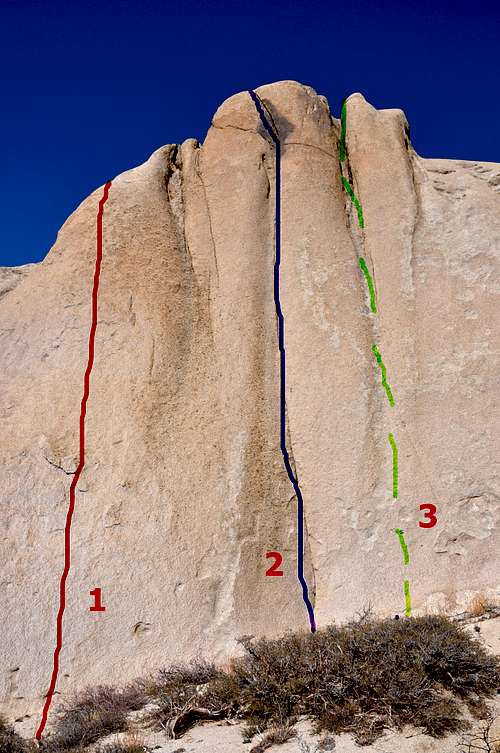
At first look, Wavelength seems to be a featureless rock formation with no climbing potential. But, as you get closer you will see small crystals and flakes on a less than vertical face. Because there are very few large holds, there are not not very many routes on Wavelength, but it’s a great place for more accomplished climbers who are comfortable on 5.11 and 5.12 range. In the old times, climbers had to throw a rope over the top of Wavelength to the opposite side and anchor it to the base of Windy Wall. Nowadays, however, there is an anchor on the top of one of the two bolted routes that can be used for rapping off.

A personal note: Of the dozen times that I have climbed on Windy Wall, I was completely ignorant to the existence of Wavelength. I stumbled upon Wavelength completely by accident in the winter of 2008. It appears that I was not the only one not aware of this wonderful little formation. It seems to be comfortably tucked back inside a corridor along with many other small and large boulders.
| Climbs of Wavelength | |
| 1 | If I Wanted Any Sh@t From You..., 12a, bolts |
| 2 | Wavelength, 11c, gear to 2.5 inches, there is one bolt half way up |
| 3 | Project, has one bolt |
Although the bottom half of Wavelength seems to be featureless, the top half actually has cracks leading all the way to the top. The blankest face on the left has one bolted climb called “If I Wanted Any Sh@t From You..., 12a” with an anchor on top. To the right of that climb you will find the original route on this wall. It’s named “Wavelength, 11c,” established in the early 1980’s. It’s a thin crack and hard to protect. There is one bolt two thirds of the way up it.
There is a project to the right of those climbs with one bolt. To the right of all of those you will find a crack that seems not that hard. Unfortunately, I do not have any more information about that climb.
Y-Boulder
Y-Boulder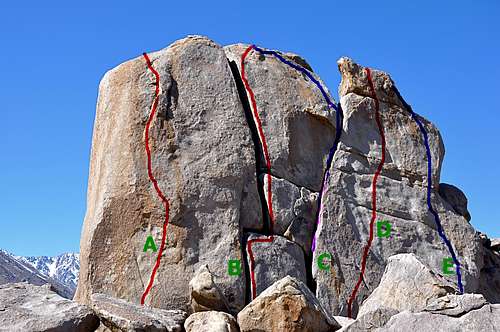

West face of Y-Boulder
The west face of Y-Boulder is a seemingly featureless vertical face. This lack of larger features did not stop a hard man like Tom Herbert from establishing a four bolt climb on this face. I guess it was pure faith, or self confidence, that resulted in “Faith, 12c.”
Climbs of Y-Boulder | |
| A | Why left, 10c, bolts and gear |
| B | Left Y-Crack, 5.9, wide crack, come prepared for off-width climbing, gear protection up to 6 inches |
| C | Right Y-Crack, 5.8, standard rack up to 3 inches |
| D | Why Center, 10a, not well protected, runout |
| E | Why Right, 10b, bolts |
Dune
Dune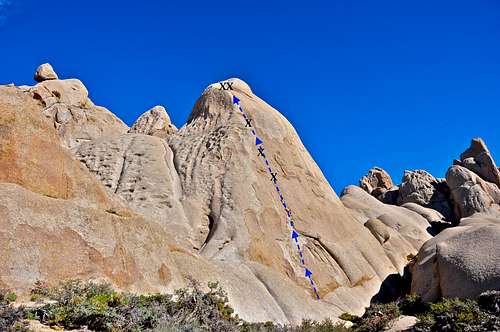
Dune is a formation in The Buttermilks Area of Sierra Nevada Range, California.
Although Dune is not the tallest formation in this area, it's definitely more noticeable than its close neighbors Skin Diver and Wrangler Rock. This prominence is due to its cone shape and its proximity to the Frontside Parking area. The first ascent of this rock was done by the Sierra rock climbing pioneer Alan Bartlette in 1986. Considering many more recent bolting practices, some as low as seven feet for the first bolt, this route may give some clues as to the higher standards of three decades ago.
This interesting formation does not get very much traffic due to the fact that it's not for the faint of heart. Dune has only one route, named Dune, rated 5.9, and that one route is badly runout. The greatest concern is getting to the first bolt which is nearly half way up the rock. Falling before clipping the first bolt can result in serious injury or death. Granted, reaching the first bolt is not the difficulty crux of the route, but it is certainly is the psychological crux of the route. After the first bolt you have two more bolts to clip. Climbing this section is the technical crux of the route. You are moving mostly on friction with tiny crystals for your finger tips. The top of the rock, however, is pleasant and is equipped with two bolts for your anchor and rappelling back down to the base.
Rump Rock
Rump Rock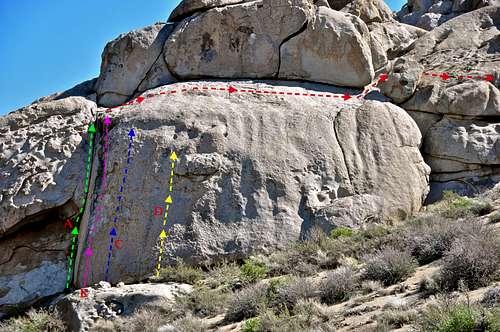
Rump Rock is a formation in The Buttermilks Area of Sierra Nevada Range, California.
There are not very many formations in The Buttermilks area that can easily be top roped. Rump Rock is certainly one that can be. The approach to the top is done from the right side, as you are looking at the rock, and as it's clearly visible from the photo, there are plenty of cracks for setting up your anchor.
Well isolated from the most concentrated grouping of formations that include Skin Diver and Wrangler Rock, this small formation is located passed the backside parking area and to the right of the road. Considering the fact that most visitors to this area come for the world-famous boulders, it should come as no surprise that you may end up having the rock all to yourself all day long.
Except for a prominent crack on the left side, the rest of the routes are on the smooth face on the highest section of the rock. Looking from the bottom, you may wonder where all the holds are! The holds are really mini crystals and edges on the less-than-vertical face. These routes are protected very sparsely by one or two bolts each. Except for the crack on the left, my personal opinion is for these face routes to be top-roped, and not done on lead.
| Routes of Rump Rock | |
| A | Rumpadoodle, 10a, standard rack |
| B | Because It's There, 5.9, bolts, no anchor |
| C | Little Creatures, 5.9, bolts, no anchor |
| D | Mikey Likes It, 5.8, one bolt, no anchor |
Camping
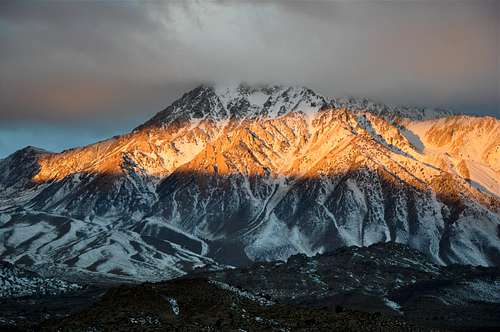
Mount Tom, another beautiful mountain view from The Buttermilks

camping in bad style
There are many campgrounds nearby that can be used. Do your best to use the campgrounds, at least for extended stays. In addition to the nearby campgrounds, there are many unofficial campsites, some near running creeks, that can be used. In any event, camping in the parking areas is the worst to choose.
The following links should help finding a good campsite
Horton Creek Campground
Rock Creek Canyon
Inyo National Forest
Bishop Creek and vicinity camping
How to get there
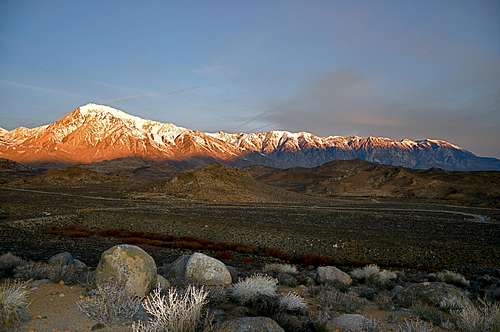 |
|---|
Approach to Windy Wall and Wavelength is as follows:
From the town of Bishop California drive seven miles on Highway 168, also known as Line Street, to its intersection with Buttermilk Road. Take this dirt road for 3.5 miles to a broken gate. To your right you will see many boulders of all sizes. These are the famous Buttermilks Boulders. Turn right after the gate and soon you will see a large clearing to your right. This is known as the “Back Parking.” Park your car here.
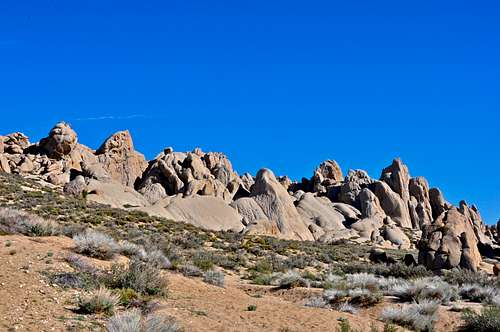
To get to Windy Wall walk down the road you were on and walk for .2 miles to its intersection with a steep dirt road on your right. Hike up this steep dirt road to a wide clearing in the brush. Continue walking past this clearing for another two hundred yards to a point where you can see a gabled rock formation to your left. The small gable-shaped rock in the middle is your landmark {refer to the photo}. There is a narrow trail leading to an obvious corridor and Windy Wall itself. Walking time is about five minutes.
To get to Y-Boulder drive another .5 miles on the back side dirt road.
 10 Mountains & Rocks