

-
 15730 Hits
-
 85.36% Score
-
 20 Votes
 Page Type:
|
Mountain/Rock |
|---|---|
 Lat/Lon:
|
51.26530°N / 115.7736°W |
 Activities:
|
Mountaineering, Trad Climbing |
 Season:
|
Summer |
 Elevation:
|
9540 ft / 2908 m |

|
Overview
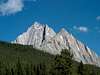
Mount Ishbel is located in the Bow River Valley east of Johnston Canyon in Banff National Park, one of four connecting national parks located in the heart of the Canadian Rockies. This peak first caught my attention several years prior when I skied up to the well-known “Ink Pots” above Johnston Canyon. As part of the Sawback Range, many consider Ishbel the most sawback-like of the group, including Mount Louis, Mount Cory, Mount Edith, Mount Norquay and/or The Finger. This is due in part to a glacier that undercut the southeast facing slopes of Mount Ishbel resulting in a massive slide some 8000 years ago. Mount Ishbel was officially named in 1956 after a daughter of a Great Britain Prime Minister. It was first ascended in 1933 by Packer, Waters, Farish, Innes, DeCouteur and Sterling guided by the legendary Lawrence Grassi.


There are no published routes up Ishbel that I am aware of. The notes we had would fit on the back of a business card. Due to the rappels involved to complete a circuit of the mountain (south ridge to east ridge), I would have to rate Ishbel an Alpine I climb versus a difficult scramble. There are no published ski routes up the mountain. The summit affords great views of Mt. Assiniboine as I caught a good glimpse of her while on the ridge and before storm clouds moved in on us. Of course being in the Bow Valley, the closer views include Copper Mountain, Storm Mountain, Ball Mountain, Castle Mountain, The Finger, Mount Bell, etc.
 |  |  |
Getting There
The Trans-Canada Highway dissects Banff National Park east to west as you come in from Calgary. Bypass the Banff town exits and take the Bow Valley Parkway exit. Turn right and follow the scenic parkway (90% of the time there are bull elk visible from the road as was the case on the day of our ascent) past the Sawback Picnic Area to a large meadow on your right. The long south ridge of Mount Ishbel begins northeast of this meadow and is clearly visible from the road. There is a pullout on the left. The Bow Valley Parkway is normally closed to traffic for wildlife purposes from 6:00PM to 9:00AM until June 25th each year. However, there is no gate and I am not aware of the proper etiquette for climbers regarding this restriction.Red Tape
You will be required to purchase a national park pass as you enter the park. This pass is good for all four national parks. If you plan many visits to Canadian National Parks within one year, you should purchase an annual pass. There are no permit requirements to climb in Banff National Park, but all camping is regulated. There is also a backcountry permit required if you plan on spending a night in the backcountry versus the town campsites. This can be obtained via the parks website which is included in the camping section below. Park headquarters are located in Banff and you will drive through the manned kiosks as you enter the park.This is active grizzly country, therefore, you should always have bear spray on your person. We just had a grizzly fatality in Canmore, June, 2005. I advise checking with Parks Canada for any area and/or trail closures.
 1 Routes