


 Page Type:
|
Mountain/Rock |
|---|---|
 Lat/Lon:
|
39.22930°N / 113.7228°W |
 County:
|
Millard |
 Activities:
|
Hiking |
 Season:
|
Spring, Summer, Fall, Winter |
|
Elevation:
|
8144 ft / 2482 m |

|

Overview
A rarely visited peak in the western Utah desert that isn't all that far from the Great Basin National Park. Conger Mountain is the highpoint of the northern section of the Confusion Mountain range and has appeal for those who are into chasing the 100 highest Utah prominence peaks. Almost at the bottom of the list, Conger Mountain comes in at #99 on this list that is put out by John Kirk on his fine website known as Lists of John. The effort he has made to put this information together is extremely impressive.What other reasons besides peakbagging would take somebody to this area you might ask? Thanks to the lack of light pollution, this is a outstanding area for studying the night skies with a telescope. It is also an area that ATV'ers are fond of but don't visit in overwhelming numbers due to the distance it is from anywhere (see map). It is a superb place to view wildlife if you are of the patient persuasion. What kind of wildlife? Proghorn antelope call this area their home as do wild horses. Conger Mountain is home to deer and of course mountain lions and other desert adapted wildlife
species. The wild horses are part of the Conger Herd Management Area which you can read more about HERE.
However, peakbagging is what attracts people like me and that is why I found this area worth a visit. I did have a proghorn antelope race me for a half mile or so down one of the dirt roads and to show its superior speed,
it cut right in front of my truck and left me in the dust. Oh how I wish I had a video of that exciting encounter.
Getting There
From Salt Lake City, head to Delta Utah and head west for 75 miles on highway50/6 as it heads for Great Basin National park and Ely Nevada. At the milepost marker 16, take the dirt road that heads north at that point (the little valley road) and continue on it until you reach a signed turnoff for Conger Spring. A passenger type vehicle can drive this road to Conger Spring
in good weather. Park near Conger Spring and begin your hike from there. If you have a high clearance 4WD vehicle, you could drive a very rough half mile further until you come to a washout that stops everyone other than an ATV.
From Great Basin National park or from Ely, go 16 miles from the Nevada-Utah border on US 50/6 and turn north on the Little Valley road, taking the dirt road to the turnoff for Conger Spring and driving to the end of this road which ends at Conger Spring.
 The Little Valley road in
 Map 1
Map 1 Map 2
Map 2Route description
From Conger Spring, it is less than 4 miles to the peak and involves an elevation gain of less than 1600 feet. The map shows the route that Greg and I utilized but of course, this peak could be reached from just about any other direction due to the non technical aspect. At no time did our approach go beyond class two. In warmer times, rattlesnakes might be a concern but it was cool and had been cold the night before when we visited the area.
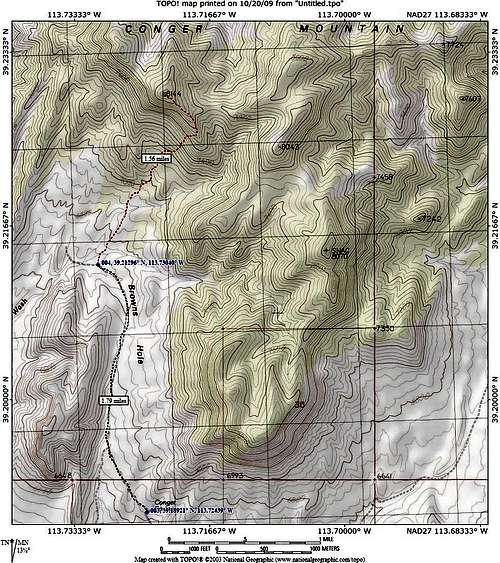 Route map
As of Sept. 2015, I only know of 7 people who have visited this one.
??? - Gordon MacLeod and Barbara Lilley (Calif)
2009 - John Vitz
2009 - Greg Jagielski and Dean Molen
2010 - Jason Hardink
2014 - Victor Zhou
2015 - Sam Grant (see GPS track at peakbagger)

Red Tape
This mountain is located on BLM land and a wilderness study area designation impacts some of the existing roads that are in the area. Read the following BLM publication for more detail. READ HERE. A book has been published which includes some information on the Conger Mountain Wilderness study area and is readily available on Amazon. I'll include some excerpts fromthat book when this page is just about finished. A blm pdf document can be found here.
For more information:
Salt Lake Field Office
2370 South 2300 West
Salt Lake City, UT 84119
(801) 977-4300
Camping
Good camping is available in the Great Basin National parkCamping on BLM land
If you choose to camp near the mountain, please observe the "leave no trace"
rules and pack out all your garbage.
Supplies:
Baker Nevada
Delta Utah
Motel rooms at the Utah/Nevada border
RV typecampgrounds
Weather for the area


The summit
 Summit cairn
 Greg at the summit
The western desert
Due to the remote nature of this area, always carry adequate water and make certain you have enough gasoline. Gas is available at the Border Inn, 16 miles away from the turnoff to Conger Mountain but pay attention to having self sufficiency capability for traveling in this area of Utah.Rattlesnakes are another aspect of the western desert and pay attention to where you step during your visit.
 1 Trip Reports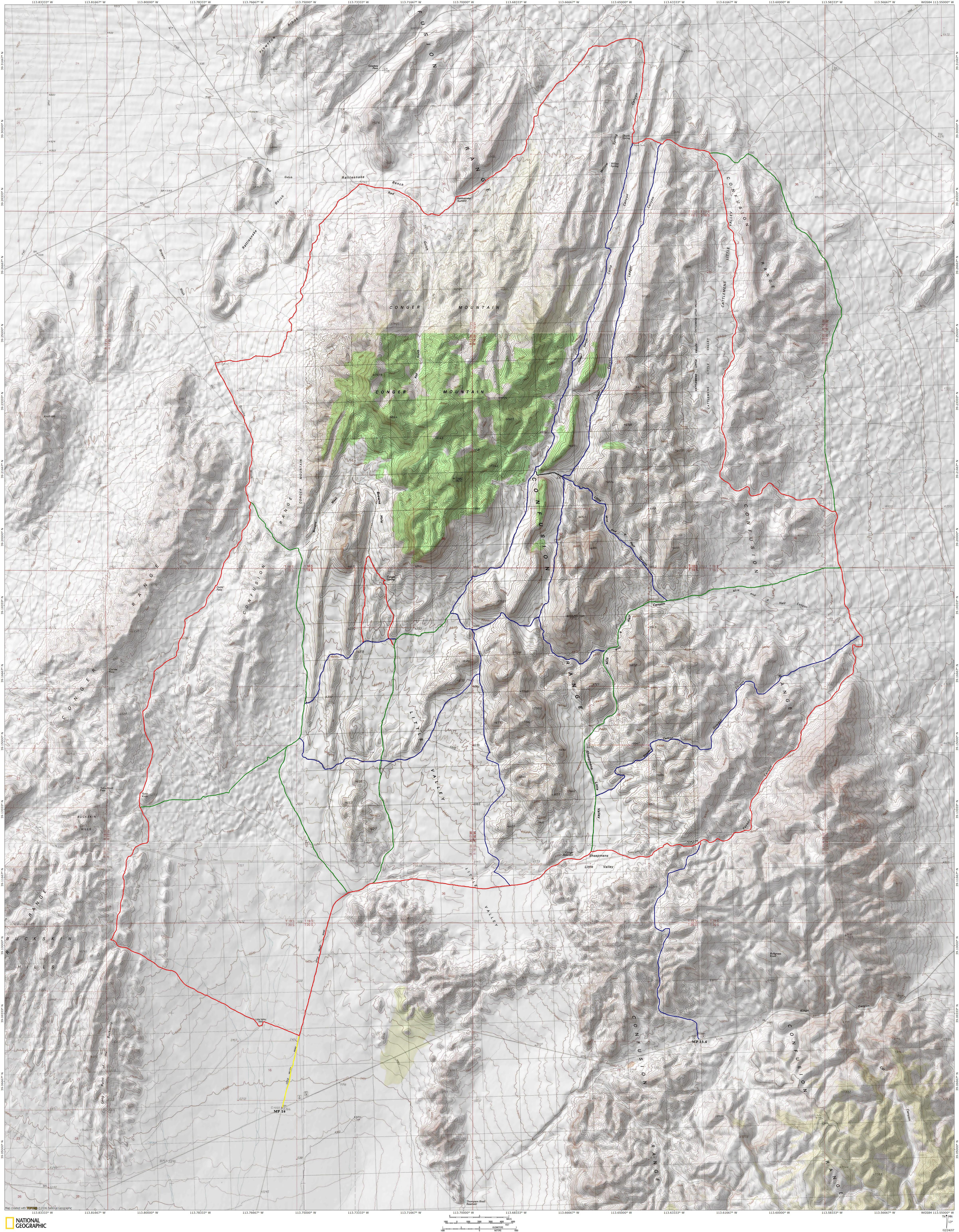
Ammon Hatch - May 21, 2012 7:35 pm - Hasn't voted
FossilsThe conger springs area was a stop on a field trip for a paleontology class I took. For anyone interested, there are abundant crinoid stems and articulate brachiopods as well as rugose and tabulate corals all of upper Mississippian age.