


 Page Type:
|
Mountain/Rock |
|---|---|
 Lat/Lon:
|
46.64300°N / 12.38100°E |
 Activities:
|
Hiking, Mountaineering, Scrambling, Via Ferrata, Skiing |
 Season:
|
Spring, Summer, Fall, Winter |
 Elevation:
|
9728 ft / 2965 m |

|
Overview
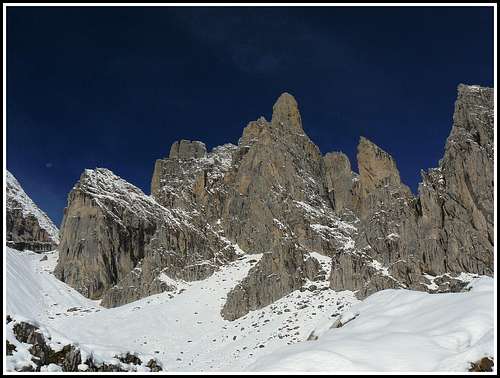 From Vallon Popera
The Croda Rossa di Sesto ( also known as Cima Dieci and Sextener Rotwand ) is a wonderful dolomitic mountain situated among some of the most beautiful peaks of the Alps, in the famous group of the Dolomiti di Sesto.
The spectacular views, the picturesque towers, the impressive rests of the First World War, the ski tracks, the “easy” access of its summit make this dolomitic jewel one of the most popular mountains of its group. Its popularity it’s probably second only after the great Tre Cime di Lavaredo
.
Actually only the north side is much frequented, because of the cableway that takes you on the plateau on the northern slopes called Prati di Croda Rossa at almost 2000 m ( if you love the Dolomiti you shouldn’t miss to go there at least once , the beauty of this place it’s almost incomparable), where you can enjoy a classic dolomitic view.
The south side towards the Vallon Popera is still quite wild, but maybe is even more beautiful. The main reason of this wilderness is the lack of easy routes for the mountains of the valley. If you want to climb the Croda Rossa from Vallon Popera you have to be at least a via ferrata expert, because the easiest route is the very difficult via ferrata Zandonella.
 From Passo di Monte Croce Comelico
 Meridiana di Sesto
The Croda Rossa di Sesto is also known as Cima Dieci, because is part of the biggest sundial of the world, "la meridiana di Sesto". The other peaks of this amazing dolomitic watch are Cima Nove ( Pala di Popera ), Cima Undici, Cima Dodici ( Croda dei Toni ) and Cima Una. If you go there don't miss the midday sun that shines just above Cima Dodici!
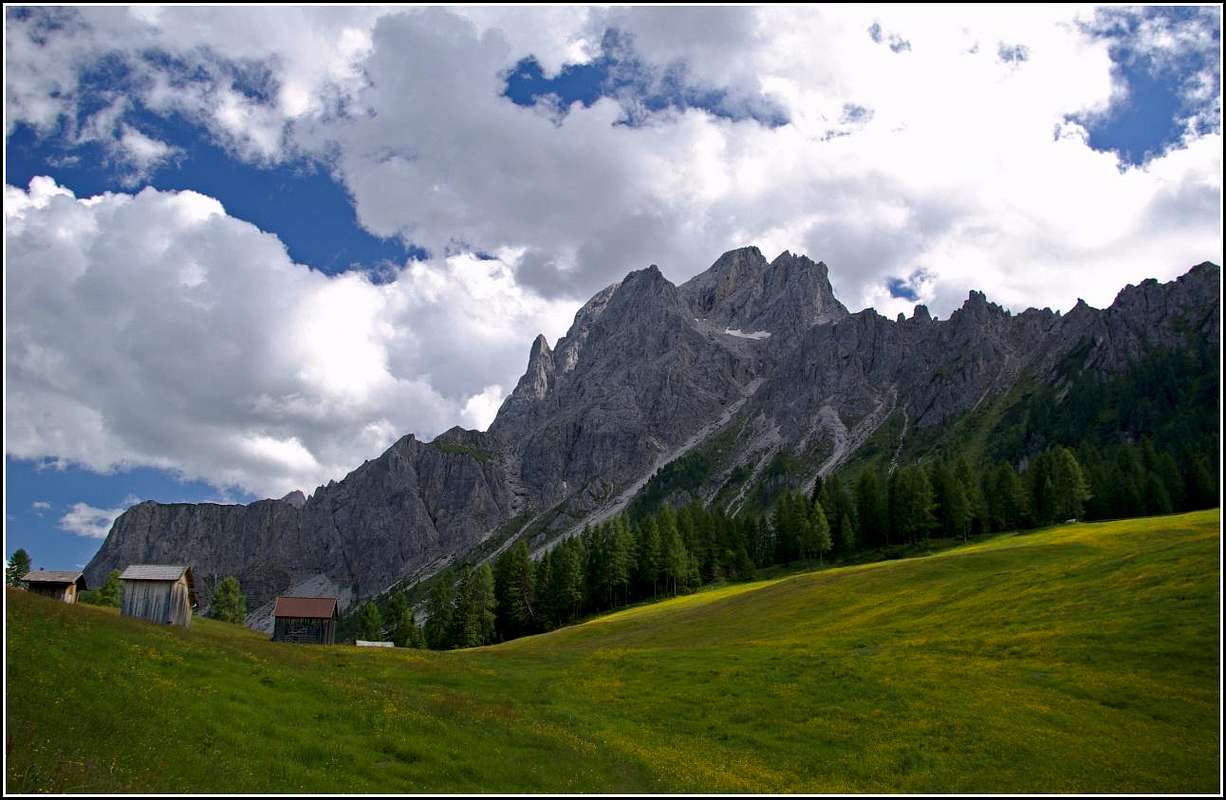
This mountain has five summits and at least a dozen of minor towers: Torre Vinatzer ( 2965 m ) it’s the highest point but it’s not the main summit, which is the Cupola Nord ( cross and summit book, 2936 m ). It belongs to the Popera group and is the main peak of a small indented massif that is composed by the following summits: Croda Rossa di Sesto ( 2965 m ), Prater ( 2745 m ), Wurzbach ( 2675 m ), Monte Castelliere ( 2168 m ), Torre Pellegrini ( 2757 m ), “Le Guglie” ( 2850 m ), Sasso Fuoco ( 2592 m ), Dente di Popera ( 2528 m ), Gobba Grande ( 2528 m ), Gobba Piccola ( 2522 m ), “Il Castello di Popera” ( 2511 m ), Pala di Popera ( 2582 m ), Croda sora i Colesei ( 2371 m ) and Campanile Colesei ( 2318 m ).
 |
|---|
 From Sesto
The mountains of the Popera group formed between the early and the middle Triassic age ( 240-200 million years ) and are mainly composed by three kinds of dolomitic rock: Dolomia del Serla ( early Trias – Anisic period ), Dolomia dello Sciliar ( middle Trias – Ladinic period ) and Dolomia del Durrenstein ( middle Trias – Carnic period ).
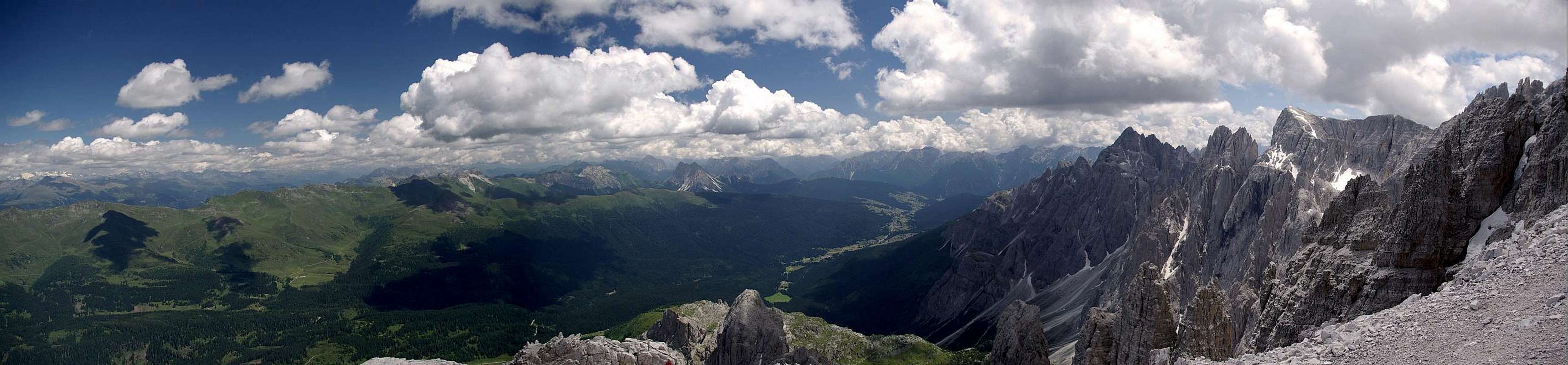
The views from the summit of the Croda Rossa di Sesto are really fantastic, even an expert of the Eastern Alps will never be able to recognize all the summits that you can see from there. If the sky is clear basically you can see all the mountains from Palla Bianca to Triglav…
The "Big War"
 Wurzbach camp
While going up to the Croda Rossa di Sesto you can’t help to notice all the rests of the First World War: this area was one of the most contended of the dolomitic frontline and fierce battles had been fought since the beginning of the war. Approaching the summit the view of the Torre Vinatzer ( known also as “the Polar”, dedicated to a famous officer of the Austrian army ), with all the caves, the trenches and the ladders, it’s probably the best image you can see to understand the sacrifice of this men, that fought a war not only against their enemy but also against the mountains and the elements. All this area, that today is a paradise for hikers and alpinists, was a real hell in those days and for that young Austrian and Italian soldiers fighting there was the worst nightmare one can imagine, especially in the winter season ( in particular the winter 1916/1917 was terrible, the coldest of the century ) .
 Torre Vinatzer
Since the beginning of the war it was clear that the summit of Croda Rossa had a great strategic importance, because it dominates all the Val di Sesto, the Val Pusteria, the Val Fiscalina ( that in those years were Austrian territory ) and the Vallon Popera and the Comelico on the other side of the line. So the Austrians, that had an easier access to the summit, started to set their positions on the crest on july 4, 1915.
The Italians tried everything to conquer the mountain but eventually they had to give up, although they had some of the best mountain troops. With great alpinistic exploits ( and many lives lost in suicide attacks and for the extreme weather conditions ) they managed to conquer the wild crests of the nearby Cima Undici and the important Passo della Sentinella ( the conquer of this pass was one of the most heroic pages of the war, here you can read the whole story in italian ), all in vain because after the rout of Caporetto, the October of 1917, all the soldiers of the italian army had to leave the mountains.
 Passo della Sentinella
 the warpath to Croda Rossa
Today this mountains are a monument to the stupidity of the war, but also to those heroes that died here for their ideals or for the freedom of their countries. After almost 100 years many things have changed, the border between Italy and Austria doesn’t exist anymore and Europe eventually seems to have found peace and stability. But it’s important to remember what happened in those sad years, to keep the greed and the hate far from this wonderful place forever.
Getting There

There are two possible ways of access:
1) Val Fiscalina ( From Moso to the Cableway station )
2) Vallon Popera ( take the road to Rifugio Lunelli before Passo di Monte Croce Comelico )
From North: From the A12 Unterinntalautobahn exit Kurfstein and then Kitzbuhel-Mittersill-Lienz-S. Candido-Sesto-Val Fiscalina
Or Sesto-Passo di Monte Croce Comelico –Rifugio Lunelli
From West: From the Brennero motorway exit Bressanone/Brixen and then S.Candido-Sesto-Val Fiscalina
Or Sesto-Passo di Monte Croce Comelico-Rifugio Lunelli
From East: From the Udine-Tarvisio motorway exit Carnia and then Tolmezzo-Forni Avoltri-Sappada-S.Stefano di Cadore- Rifugio Lunelli
Or S.Stefano di Cadore-Passo di Monte Croce Comelico-Val Fiscalina
From South: From Venezia to Belluno and then Pieve di Cadore-Auronzo di Cadore-Padola-Rifugio Lunelli
Or Padola-Passo di Monte Croce Comelico-Val Fiscalina
Summit Views
 |
 Croda Rossa d’Ampezzo Croda Rossa d’Ampezzo |
 Tre Scarperi Tre Scarperi |
 Monte Popera Monte Popera |
 Cima Bagni Cima Bagni |
 Tre Cime di Lavaredo Tre Cime di Lavaredo |
 Dolomiti Orientali Dolomiti Orientali |
 |
Routes overview
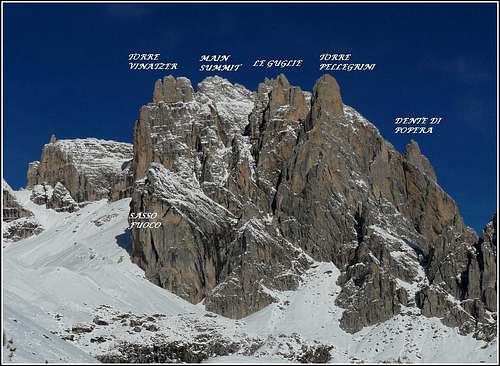 Croda Rossa from Vallon Popera
You have two options if you want to climb the Croda Rossa di Sesto:
Via Ferrata Croda Rossa: easy via ferrata on the north side, much frequented in the summer months, great views of the Dolomiti di Sesto.
Via Ferrata Zandonella: This route has been opened in 1978 and is dedicated to Mario Zandonella, a local mountaineer died climbing Monte Pelmo in 1975. Actually the routes are two: the very difficult ferrata on the south face and the easier ( but also difficult ) variation on the south-east face, used mostly for the descent. Also on this side you will see a lot of rests of the war and you will enjoy spectacular views of the imposing mountains of the Popera group.
Just before Passo di Monte Croce Comelico turn left following the indications for Rifugio Berti/Rifugio Lunelli. Park your car near the Rifugio Lunelli and take the path n°101 to Vallon Popera. After one hour or so you will reach the Rifugio Berti, where the view opens completely to all the valley. Take the path to passo della Sentinella and before the pass turn right following a track that will take you at the base of the south face of the Croda Rossa. The route follows a vertical line on the face and is very challenging since the beginning. Just before the summit it meets the other path that comes up from the north. The SE variation starts from the saddle between the Guglie and the Torre Pellegrini, that is very hard to reach because you have to go up on a very strenuous ravine, that’s why it’s used only for the descent.
This via ferrata can be rated as difficult, there are very exposed vertical passages so is recommended only to experts. Elevation gain: 1400 m – 8/9 hours
Red Tape
This mountain is inside Parco delle Dolomiti di Sesto , there are no fees to pay, just remember that you are in a protected area.When to climb?
From June to october, on the northern side some years you can find snow until july.Meteo Val Pusteria
Webcams
Accomodation
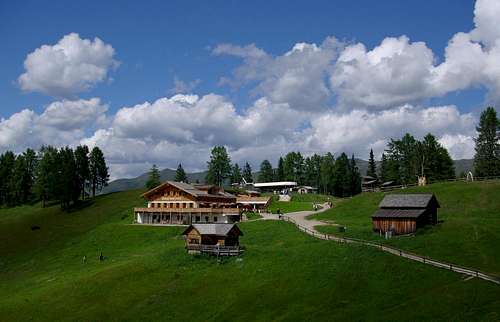 Rifugio Rudi
This is a very popular touristic area, so you won’t have problems to find accomodation. July-August and December-January are the busiest months.
If you like alpine huts you will sure find one for your taste among the many of the Dolomiti di Sesto.
Sesto Hotels
S. Candido Hotels
| Hut | valley | elevation ( m ) | tel. number |
| Rifugio Berti al Popera | Vallon Popera | 1950 | +39 043567155 |
| Rifugio Zsgismondy-Comici | Alta Val Fiscalina | 2224 | +39 0474710358 |
| Rifugio Fondo Valle | Val Fiscalina | 1526 | +39 0474 710606 |
| Rifugio Carducci | Val Giralba | 2297 | +39 0435 400485 |
| Rifugio Lunelli | Val Grande | 1568 | +39 0435 67171 |
| Rifugio Pian di Cengia | Pian di Cengia | 1950 | +39 0337 451517 |
| Rifugio Prati di Croda Rossa | Prati di Croda Rossa | 1924 | +39 0474 710102 |
| Rifugio Locatelli alle Tre Cime di Lavaredo | Val di Landro | 2405 | +39 0474972002 |
In this website you can find info of all the huts and the bivouacs of the area.
Maps and books
Tabacco maps 1:25000
010 – Dolomiti di Sesto
Kompass maps 1:25000
WK 625 Sextener Dolomiten-Dolomiti di Sesto
Books
Dolomiti e Brenta – Guida alle ferrate – E. Husler – FK editore
Dolomiti di Sesto, di Braies e dintorni – G. Cenacchi – Zanichelli Editore
I signori delle Cime – I. Zandonella Gallagher – Grafiche Antiga
La Grande Guerra sul fronte dolomitico – B. Di Martino – Rossato Gino Editore
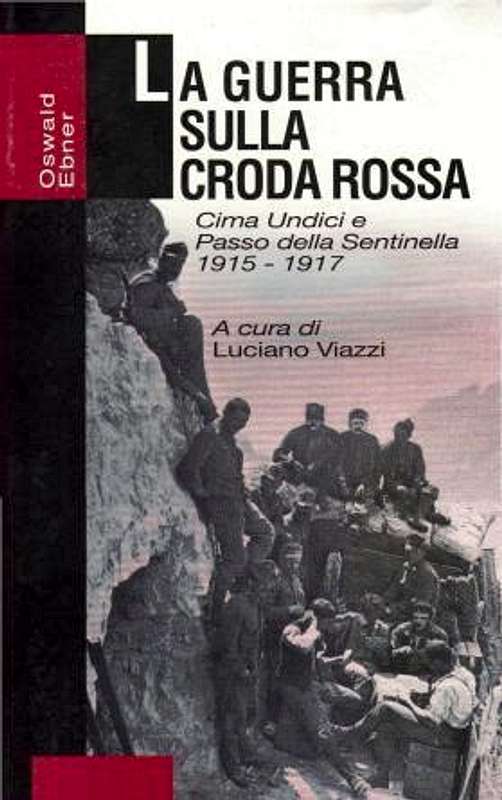
La Guerra sulla Croda Rossa – E.Oswald – Editrice Mursia
Guerra per Crode – Antonio Berti – Nordpress
Sextener Dolomiten Extrem – Alpenveirensfurer – R.Goedeke – Rother Verlag
Klettersteige Dolomiten – H. Hofler, P. Werner – Rother Verlag
Hulslers Klettersteigfurer – E.E. Husler – Bruckmann Verlag
 2 Routes