

-
 275315 Hits
-
 100% Score
-
 245 Votes
 Page Type:
|
Mountain/Rock |
|---|---|
 Lat/Lon:
|
27.98818°N / 86.92457°E |
 Elevation:
|
29032 ft / 8849 m |

|
Overview and initial attempts
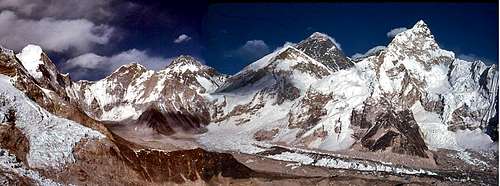
Everest seen from Kala Pattar in February 1986
"Chomolungma or Qomolangma"
to Tibetans, meaning
"Mother Goddess of the Earth". "Sagarmatha"
meaning
"Goddess of the Sky"
to the Sherpa people,
(invented in the 1960s by Baburam Acharya in response the the rising question that the Mountain had no Nepalese name)
Mount Everest gets its European name from British Superintentant General of the Survey of India 1830-1843, Sir George Everest.
The ancient name for the mountain is Devgiri, meaning "holy mountain" or Devadurga may have been pronounced it as deodungha by the English in the 1800s.
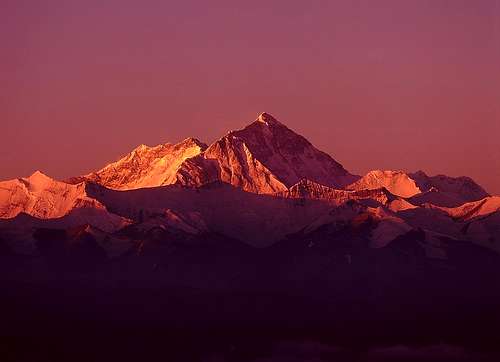
The North face of Everest
- One of the first recorded viewings by a European was in 1913 by Captain John B. Noel.
- In 1920 Sir Francis Younghusband received permission for an expedition to Everest from the Dalai Lama. This first team was headed by Charles Kenneth Howard-Bury. Climbers on this team included: Harold Raeburn, Alexander Mitchell Kellas, A.F. R. Wollaston, G. H. Bullock and George Leigh Mallory. While this expedition failed it did provide important information on the surrounding area and possible future routes.
Info from mac9805b (in italics)
- In 1921 Mallory did a scouting expedition to the base of the west ridge at Lho La pass (5,981 meters). From here they examined the South Col Route and named the area below the Lhote Face the "Western Cwm". They also dismissed the South Col as a possible route, because of the "impassible" Khumbu Icefall. Since Nepal's borders were closed before World War 2, they would not have been able to attempt this route.
The 1922 British expedition reached a high point of 8,320 meters. This was also the first recorded use of bottled oxygen in Mountaineering.
The 1924 British expedition set two height records. The high point of the expedition was 8,573 meters, which stood as the highest point ever climbed for 29 years until the first ascent in 1953 (assuming Mallory and Irvine did not summit). It was also the highest point climbed without oxygen for 56 years until Reinhold Messner and Peter Habeler summited without oxygen from the South Col. Andrew Irvine's body was discovered by Chinese climber Wang Hong Bo in 1979 at 8,150 meters. The Chinese said that his camera was not found with the remains, though some western climbers allege that the Chinese took it. If they did take the camera, with possible summit photos, it would be buried in the avalanche that killed Wang Hong Bo the day after discovering the body. Noel Odell has stated that he saw Mallory and Irvine nearing the base of the second step at about 12:50 pm on June 8, 1924. He said they appeared to climbing strongly.
George Mallory's remains were discovered in 1999 by American Big Wall climber Conrad Anker on the International Mountain Guide expedition led by Eric Simonson. Mallory was found in a self arrest position, suggesting that his cause of death was a fall on the descent. His camera was nowhere to be found.
It has been suggested that the 30 meter vertical rock wall called the second step prevented Mallory and Irvine from summiting in 1924. Due to the extreme altitude and cold, it has long been considered unclimbable. The Chinese expedition to the North Ridge in 1975 installed a ladder here, which is still in use today. However, in 1999 Conrad Anker freeclimbed the second step by jamming the crack just to the left of the ladder with gloves and plastic boots.
- In 1922, General Charles Granville Bruce, lead another attempt from Tibet. Climbers on this expedition included: Lieutenant Colonel E. L. Strutt, George Leigh Mallory, George Ingle Finch, Howard Somervell, William Wakefield, Edward Felix Norton, Tom Longstaff, Captain John Noel, Geffrey Bruce and John Norris. This expedition while providing more valuable information also failed along with the unfortunate death of seven porters.
- In 1924, General Charles Granville Bruce again headed an expedition from Tibet. Climbers included on this team were: Edward Norton, Howard Somervell, John Noel, Geoffery Bruce, Noel Odell. Bentley Beetham, John de Vere Hazard, Andrew Irvine, E. O. Shebbeare and Dr. R.W.G. Hingston. This adventure failed and included the legendary deaths of George Leigh Mallory and Andrew Irvine. These two climbers were last seen and photographed on June 8th 1924 by geologist Noel Odell. A man I was privileged to meet at one of his lectures at McGill University in the early ninteen-eighties. Although he was in his eighties he was very sharp and I remember that his hands seemed twice the size of mine.
For eight years the Dalai Lama refused permission for any further excursions to Everest. Then in 1933 permission was again granted.
- Hugh Ruttledge lead a group comprised of: Eric Shipton, Francis Sydney Smythe,E. St. L. Birnie, Raymond Green, Dr. W. MacLean, Colon Crawford, Percy Wyn-Harris, Laurence Wager, Jack Longland, Major Hugh Boustead, T.A. Brockleband, George Wood-Johnson, E.O. Shebbeare, E.C. Thompson and W.R. Smith-Windham. The route was the North col and unsuccessful.
- Eric Shipton lead a group including Harold Tilman, Dr. Charles Warren, Edwin Kempson, Edmund Wigram, Michael Spender, L.V. Bryant, P.R. Oliver, James Gavin, W.R. Smyth-Windham, Dr. Noel Humphreys and a young sherpa named Tenzing Norgay in 1935. They followed the route previously set out by George Mallory but were unsuccessful at reaching the summit. The expeditions of '35, 36' & '38 are all sort of lumped into one, described as '35. Hence, some of the members of '36 and '38, who were not on the '35 expedition. A correct listing of expeditions and expedition members can be found at:www.billbuxton.com/BritishEverest21-53.pdf info thanks to Bill Buxton
- In 1947 a Canadian named Earl Denman and two sherpas secretly attempted the north col route but failed.
- In 1950 the Chinese invaded Tibet thus closing the border to Europeans for a couple of years.
- Spring of 1951 saw a Dane, Klas Becker Larsen attempt Everest for the first time going through Nepal. Crossing a pass west of Cho Oyu. Bad weather conditions and possible arrest by the Chinese forced him to abandon his attempt of the north col.
- The fall of the same year 1951 saw another British attempt lead again by E.E. Shipton. Team members wre: Micheal Phelps Ward, Thomas Duncan Bourdillon, William Hutchison Murray, Dr. Dutt, Edmound Hillary and H.E. Riddiford. This time the mountain was to be attempted by the south col route in Nepal. The team succeeded in getting above the icefall but no further and were unsuccessful.
- The spring of 1952 saw a team of Swiss lead by E. Wyss-Dunant, which included. Renittert, Androch, Raymond Lambert, Ernst Hofstetter, Jean Jacques Asper, Gabriel Chevalley, Leeon Flory and Tenzing Norgay. Halted by bad weather in the south col this team was unsuccessful.
- The fall of 1952 saw a new team of Swiss lead by Gabriel Chevalley, which now included. Raymond Lambert, Gustave Gross, Ernest Reiss, Jean Busio, Arthur Sp?, Normand Dyhrenfurth (an American) and Tenzing Norgay. Halted by bad weather and the death of a Sherpa this team was unsuccessful.
Some notable successes
| Date | Team | Notable Event | Route |
| May 29, 1953 | British team led by H.C.J Hunt | Edmund Hillary (NZ) and Tenzing Norgay (Sherpa) were the first to summit Everest | South Col |
| May 23, 1956 | Swiss team led by Albert Egler | May 23rd Ernst Schmied and Jarmet summit. On May 24th Adolf Reist and Hans Roudolf von Gunten summit. | South Col |
| May 25, 1960 | Chinese team led by Shih Chan-chun | Gonpa (Tibet), Chu Yin-hua and Wang Fu-chou summit | North Col/Northeast Ridge |
| May 1, 1963 | U.S. team led by Norman Dyhrenfurth | Nawang Gombu (Sherpa) and James Whittaker summit | South Col |
| May 22, 1963 | U.S. team led by Norman Dyhrenfurth | Barry Bishop and Luther Jerstad summit | South Col |
| May 22, 1963 | U.S. team led by Norman Dyhrenfurth | Tom Hornbein and Willi Unsoeld summit | West Ridge/Hornbein Couloir |
| May 1965 | Indian team | A.S Cheema, Nawang Gombu (Sherpa?), Sonam Gyato, Harish Chandra S. Rawat, Phu Dorje (Sherpa), Sonam Wangyal, C.P. Vohra, Ang Kami and Hari al Singh Ahluwalia summit. | South Col |
| May 11, 1970 | Japanese team (Saburo Matsukata | Terup Matsura and Naomi Uemura. May 12th Katsutoshi and Sherpa Chotare summit. | South Col |
| May 5/7, 1973 |
Italian team lead by Guido Monzino |
Rinaldo Carrel, Mirko Minuzzo, Shambu Tamang and Lhakpa Tenzing (Sherpas) summit. May 7, Virgino Epis, Fabrizio Innamorati, Sonam Gyalzen (Sherpa?) and Claudio Benedetti summit. | South Col |
| October 26, 1973 | Japanese team lead by Michio Yuasa | Hisashi Ishiguro and Yasuo Kato summit | South Col |
| May 16, 1975 | Japanese women's team lead by Eiko Hisano | First women to summit was Junko Tabei as well as Ang Tsering (sherpa). | South Col |
| May 27, 1975 | Tibetan/Chinese team lead by Shih Chab-chun | Second women to summit was Phanthog as well as Hou Sheng-fu. Tsering Tobgyal, Ngapo Khyen, Kunga Pasang, Samdrub, Sonam Norbu and Lotse | North Col/ North Ridge/ Northeast Ridge/ route |
| September 24/26, 1975 | British team lead by Chris Bonington | Sept 24th, Doug Scott and Dougal Haston Sept 26th Pete Boardman, Pertemba (Sherpa) and Mick Burke | Southwest face (first) |
| October 8, 1976 | British/Nepalese team lead by Tony Streather | John Stokes and Michael Lane | South Col |
| May 8, 1978 | Reinhold Messner | Reinhold Messner, Peter Habeler first ascent without oxygen | South Face |
| May 13/15, 1979 | Team from former Yugoslavia - Slovenian (mostly) and Croatian |
The first complete ascent through western ridge; on summit were Jernej "Nejc" Zaplotnik, Andrej Stremfelj, Stane Belak, Stipe Bozic and Sherpa Ang Phu who died on descent |
Western Ridge |
| February 17th,1980 | Poland |
Leszek Cichy and Krzysztof Wielicki February 17 th, 1980. Polish expedition, leader Andrzej Zawada. First winter ascent of Everest. |
South Col |
| August 20, 1980 | Reinhold Messner | First summit by way of North Face route via the north ridge | North Face/North Ridge |
| 1982 | Canadian Team | First Canadian summit. Laurie Skreslet. Three days later Pat Morrow | South Col |
| October 8th, 1983 | C. Buhler,K.Momb,L.Reichardt climbed east face for the first time. | ||
| 1986 | Canadian Team | 1986 First North American woman, Sharon Wood, Canada. Also summiting Dwayne Congdon, Canada | |
| May 23, 2003 | Speed Record. May 26, 2003. Lakpa Gelu claimed the record with a time of 10 hours and 56 minutes | ||
| May 26, 2003 | Previous Speed Record. May 23, 2003. Pemba Dorje, set the previous record of 12 hours and 45 minutes only three days earlier. | ||
| May 30, 2004 | Russian Team | Pavel Shabaline, Iljas Tukhvatullin and Andrew Mariev summited Everest via the center of the North Wall - a new route. Story | North Wall |
1984 Bulgarian West Ridge expedition . Author: taikavuorimies Date: Jan 12, 2006 1:58 PM On April 20 1984 Hristo Prodanov became the first Bulgarian to summit mount Everest and the first man ever to scale the West ridge solo and without the use of supplemental oxygen. He died while trying to descend through the West ridge. On May 8-9 four members of the same expedition made the first full traverse of Everest - ascent through the West ridge and descent through the South-East ridge (Hornbein's team did not follow the West ridge completely, they passed through the Hornbein Couloir). These four men were Ivan Valchev, Metodi Savov, Nikolai Petkov and Kiril Doskov. No one has scaled the West ridge since that expedition.
First ski descent & first married couple . Author: alex_vega Date: Dec 28, 2005 11:52 AM Mt. Everest, October 7, 2000 It was a historical day for Slovenian. Davo Karnicar, of Jezersko, Slovenia, accomplished an uninterrupted ski descent from the top of the world's highest mountain, Mount Everest (8,848m). At 8 a.m. local time (4.15 CEST), Davo started his historical ascent, fulfilling his longtime dream to which he had aspired since 1996 when a snowstorm halted his efforts. Today, in only five hours, Davo skied uninterruptedly (without taking skis off) from the top of the mountain to base camp at 5,340m. (copied from www.k2news.com) Andrej and Marija Stremfelj , first married couple on world , that is together climbed Everest on October 7 , 1990.
Pemba Dorje Sherpa, new speed record, 8 hours and 10 minutes on May 21, 2004
There must be more...... First International Hairdressers ascent ... Monty Python.
Items of interest
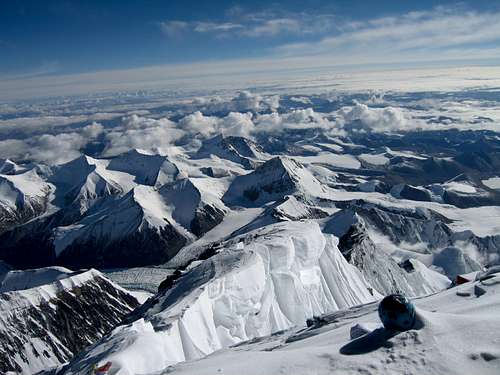
Alistair Sutcliffe's shot from the top
Current items of interest.
Hungarians on Everest!
On the 23rd of May, 2007 the second hungarian climber, Attila Jelinkó has reached the summit of Mount Everest at 3 o'clock am /CET/. The first was Zsolt Erõss in 2002. Attila Jelinkó is the first non professional hungarian climber who climbed Chomolungma!
Sad news
https://www.summitpost.org/article/618469/farewell-to-konyi.html
New book out on the Himalyan Data Base of Elizabeth Hawley
http://www.himalayandatabase.com/
Everest goes 3G
http://www.techeye.net/internet/mount-everest-mountaineers-get-3g-services
SP members summit bids
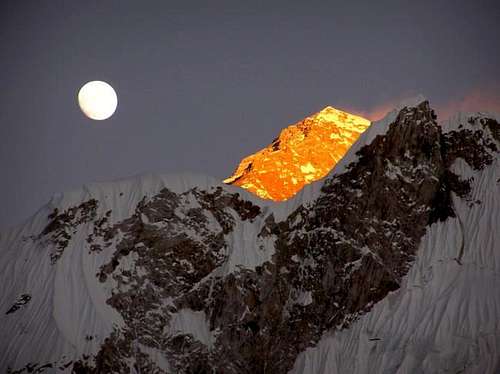
Everest by Moonlight
Read about SP member Alans Arnette’s 2003 south Col summit attempt on Everest. Check here or here
SP member Kevin Donovan attempted the North Face of Everest. You can read about it hereexpeditioneverest.com Adventure Peaks handled all the lodgistics for this expedition. Just a couple of quick items on the expedition. Enjoy! From MountEverest.Net www.mounteverest.net Photos of Gear - Before & After www.expeditioneverest.com More Just for fun! Link to a Panorama from the summit of Everest. Provided by vertx Times of India article on Spirits on Everest
Getting There
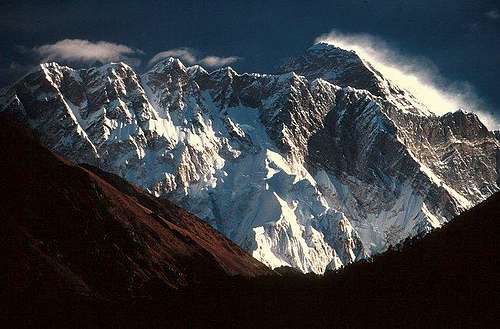
The huge bulk of Mount Everest rises above the Nuptse wall. A jet-stream driven plume of snow is an indication of the conditions up there.
To get to Nepal you will have to fly from either India, Thailand or Singapore. To get to New Delhi India try (there are many others).
Once you get to Katmandu you will have basically two options:
1 - Fly on Royal Air Nepal's Twin Otter flights to Lukla. A small air strip about ten days from Everest Base Camp (eight from Gokyo peak allowing for acclimitization) 1 hour flight approx. 2 - Take a local bus, Mini Bus hired by you or your Sherpa provider to Jiri. This is a small village at the end of the road. From here it is about a 14-16 day trek to the Kumbu region.
If you have the time do the walk. For three reasons:
1 - You will have a chance to walk through one of the most lush and beautiful lowland areas in Nepal. This is an area that a lot of trekkers miss when flying to Lukla. You will also cross over two high passes with excellent views in all directions.
2 - By taking 2 weeks to arrive in the Khumbu are and having already crossed over two high passes you will be better acclimitized once you arrive in the high peaks area. You will enjoy this more as you will be huffing and puffing less.
3 - You will be following the route taken by most of the early expeditions. There is a lot of history along that path, why not soak it up. You will also have the bragging rights that you did the same route as they in years gone by.
Flying is fast and that has its advantages. But if you have ever been at Lukla after several day s of no flights after bad weather you will understand this. (Trekkers fighting over seats to make their connecting flights home)
Note on recent bus cancellation to Juri Author: vito corleone Date: May 19, 2004 05:08 AM At the moment it is not possible to take the bus to Jiri. There are no busses going to the east of Nepal from Kathmandu because maoists shot at a public bus and killed several people, including civilists. After that, all the bus services were suspended. Nobody knows when the busses will be going again. If you really want to go to Jiri dispite of the worsening security situation (probably not a good idea) you have to hire a car. Nepal News story Still, there are no problems with maoists above Lukla. For Chinese (north side) Fly to Beijing, then to Lhasa, in occupied Tibet. Bus or truck to basecamp very long and dusty and no relief from altitude gain.
Red Tape
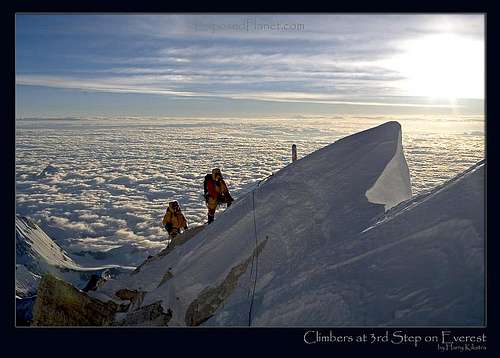
Above the third step on Everest
There are permits required. These can be arranged by yourself or the firm that you hire to support your team. There is also an entry visa to Nepal. The below can be of help. Permits The General Secretary, Nepal Mountaineering Association Post Box No. 1435, Kathmandu. Chinese to come
Helping the Sherpa/Tibetan community
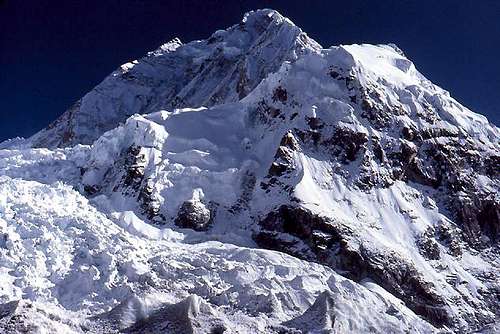
The Khumbu Icefall in 1982
There are several organizations dedicated to helping the Sherpa community. Here are just two. Should you wish to contribute to this worthwhile cause contact either of the following organizations though the information below.
The Sir Edmond Hillary Foundation
222 Jarvis Street
Toronto, Ontario, Canada
M5B 2B8
(416) 941-3315
The American Himalayan Foundation The American Himalayan Foundation 909 Montgomery Street, suite 400 San Francisco CA 94133 Telephone (415) 288-7245 Fax (415) 434-3130
VOCATIONAL TIBETAN EXPEDITION MOUNTAINEERING SCHOOL For further information please contact: Nima Tsering at: Fax: +86 891 633 6366 E-mail: nimatser@public.ls.xz.cn Hans Schallenberger at: Fax: +852 2646 5301 E-mail: hps@liwaco.com.hk
The walk in from Lukla
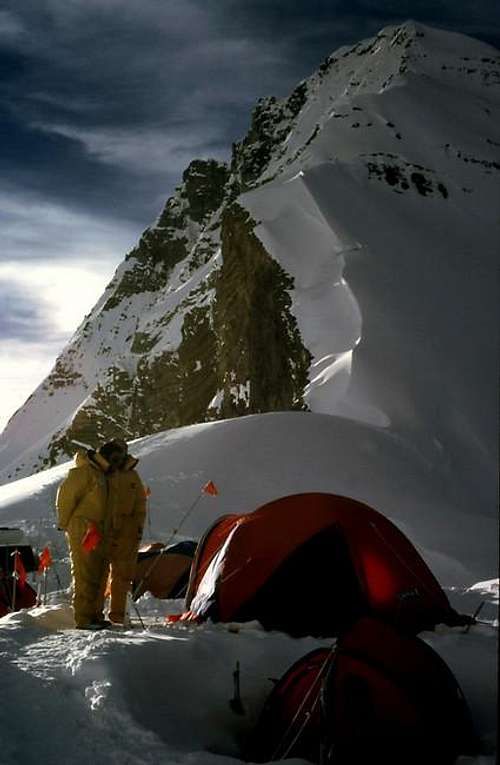
The North Col
Flying into Lukla 9,350 ft.: (Note walking times are approximate a lot will depend on how you acclimitize.)
Slowly decend to Phakding 8,700 ft. about 2 hr walk from Lukla, you will probably overnight here.
The next morning after about 2-3 hours you will pass through Jorsale 9,100 ft. Here is where you will pay a fee and enter the Sagarmatha (Everest) National Parkand. You will then continue for another 2-3 hours up hill to the main Village of Namche Bazaar 11,300 ft. This is quite an elevation gain especially for those who have flown in. You should rest here one to two days, doing small side trips ect. to acclimitize.
The next day will take you through Shyangboche 11,800 ft. (approx) then onto the village of Khunde 12,600 ft. then onto Khumjung 12,400 ft. then you decend to near the river crossing at 10,650 ft. Cross over at Pungo Tenga. Then it is uphill for two hours to Tengboche. This is another good rest spot.
The following day continue east out of the settlement and down 1.5 hours to Pangboche 12,800 ft. (keep right). Continue for 1.5 hours till you reach a fork in the trail. Go left donw to the river and cross over and uphill to the village of Pheriche (13,950 ft.). Stop here for the night. Here there is a Hospital for treating altitude illnesses. The next day or so go north along the valley floor to the end and then up to the north-east along the glacial moraine past Dunhla (15,075 ft.) (Climbers memorials) to the Village of Labouche (16,175 ft.) another 2-4 hours will bring you to Gorak Shep. From here you can go to Kala Pattar (18,450 ft.) or Everest Base Camp (17,575 ft.) or if you are going to Nupste you will have to cross the moraine to it’s base.
Guided Climbs
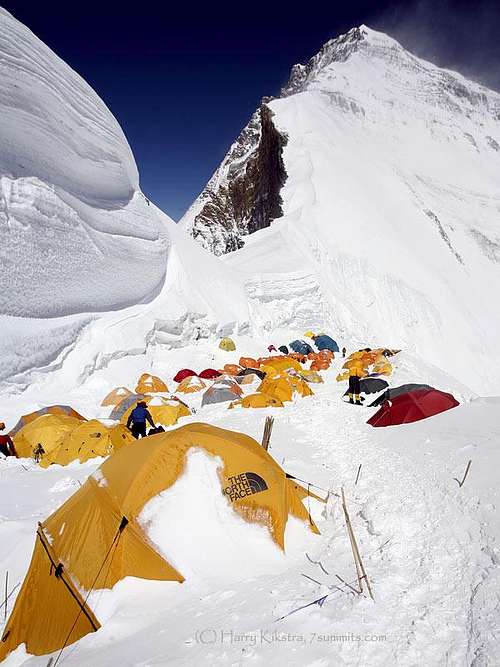
The North Col camp
If you are not able to be on an Official Expedition try one of these guided ascents
- Alpine Ascents International
- Adventure Consultants
- Himalaya Expeditions
- Earth Treks
- Jagged Globe
- Mountain-Link Expeditions
- Mountain Madness
- Mountain Odyssey
- Adventure Peaks
- Adventures International Inc. Mountain Guides
- 7summits.com
- SummitClimb
Avoiding Altitude sickness
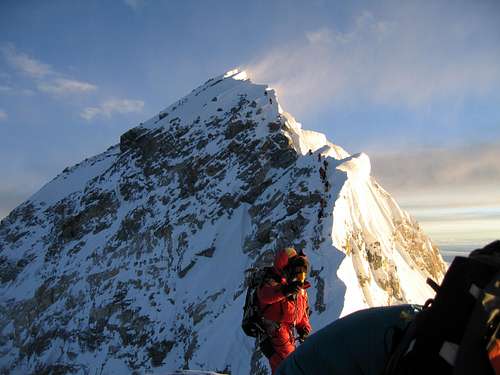
Everest. Now that's a route, Alistair Sutcliffe
You should be prepared for the possible onset of altitude sickness. High altitudes are stressful on the body, and lack of oxygen up high can produce slightly debilitating effects, such as fatigue, headaches, shortness of breath, loss of appetite, nausea, and a drunken gait. Altitude sickness generally doesn't occur below 10,000 feet, but people have suffered its symptoms lower than 8,000 feet.
There's not much you can do to prevent this problem, but there are ways of alleviating its effects. The key to doing this is simple: take it easy. Take a day or two before beginning the walk in to acclimatize yourself to the elevation. Go at your own pace, and don't take chances. Even if you're in excellent shape, don't be fooled. The lack of oxygen at such high altitudes can definitely throw your lungs for a loop. Walk at a comfortable, slow pace and don't carry too much weight. Make sure to hydrate yourself regularly, drinking 4 to 5 liters (nalgene bottles) of water per day; On some climbs camelbacks can be mountain companions because of their convenient water portability. The only problem being keeping the nozzle clean, I find they can get gross and need constant cleaning. My self I attach a 1 litre Nalgene bottle to each side of my backpack so that I can reach them easily without removing my pack. These solutions would have to be modified to suit the weather and conditions of climbing Everest. Bottles would have to be insulated and the tube from the camelback could tend to freeze up. Taking antioxidant vitamin s (A, C, and E) also helps reduce the effects of high altitudes. Of course working out before you go is another great preventative measure. While this doesn't guarantee an easier time when up high, it can enhance your lungs' ability to cope with the challenges of high elevations.
Try to spread out your ascent over a period of two or three days to give your body more time to adapt. Play by the "climb-high, sleep-low" theory of ascent: go on a short hike to a higher elevation, then return to the (lower) elevation at which you'll sleep.
Physical fitness, as mentioned above, is no guarantee against developing altitude sickness. Past excursions to high elevations without developing symptoms is similarly no guarantee against getting sick. There's no way to predict who is more susceptible to altitude sickness, although climbers who overexert themselves, those who are panting or breathless, and those who stagger far behind the rest of the group are likely candidates.
Surefire signs of impending illness include extreme fatigue, headache,loss of appetite, and shortness of breath. If you experience any of these symptoms, the best thing to do is take a break from climbing for a couple days to acclimatize. Once the symptoms disappear, it's safe for you to continue. If the symptoms persist or get worse, you should descend to a lower elevation.
More serious levels of the illness include increasing tiredness, severe headaches, vomiting, and loss of coordination, and are indicative of acute mountain sickness (AMS). If such symptoms appear, don't hesitate to get immediate medical attention. If serious symptoms go ignored for more than 12 hours, they could have dire--even fatal--effects, such as accumulation of fluid in the lungs or brain. The most important symptom of AMS is loss of coordination. If someone staggers or walks in a drunken gait, check them out for further signs of AMS. A good test is, essentially, the police's test for drunkenness--ask the person to walk in a straight line, placing one foot di rectly in front of the other without staggering or losing balance. If the person cannot perform, he or she should descend immediately--and never alone. Go slowly and without exertion, and ideally while it's light outside. Descend should continue until symptoms beg in to decrease; relief usually occurs within 1,000 to 1,500 feet.
There are prescription drugs out there that you can take for severe symptoms. One of the most common is called Diamox; it works by stimulating your breathing. Diamox is a strong medication and has some slight side effects, such as an annoying tingling in the fingers and toes. You will urinate more frequently so getting out of the tent at night in a storm could be a problem (if you don't use a pee bottle). This will also necessitate you drinking more fluids to compensate. If you take too much you can get very ill. My advice is avoid taking it if if you can.
Possible acclimitisation schedule for the South col route
Author: trunl Date: Jan 25, 2005 9:33 PM
Trek to BC- 10 days
Arrival BC April 1
Climbing C1 April 7
Back to BC April 8
Climbing C2 April 11
Back to BC April 13
Climbing C2 April 17
Climbing C3 April 19
Back to BC April 20
Trekking down April 21
Back to BC April 26
1st summit attempt May 1-7
Trekking down May 7-12
Back in BC May 13
Last summit attempts May 16-30
Mountain Conditions
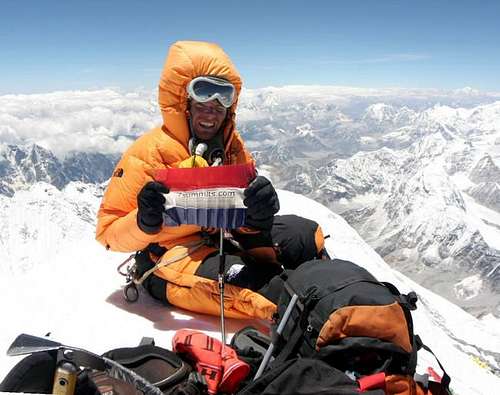
Harry Kikstra on the summit of Everest, 2nd June 2005. Windy, but with a great view.
Reading anyone of these fine books will give you the picture of the conditions to be faced.
Mount Everest : The Reconnaissance 1935
Author: Tony Astill
Date: Dec 01, 2005 06:22 AM
This new book, just published by the author in December 2005 is available from him. Please contact Tony Astill directly by post
'Arcadia' Hazel Grove, Ashurst, Southampton SO40 7AJ England.
Tel [44] (0) 2380293767 or email alpes@supanet.com
This is a hardback book of 360 pages, with 125 photgraphic illustrations now seen for the first time and 10 maps [3 folding]. The unique double dust jacket shows the fine map of the north face of Everest by Michael Spender. Ed Webster says 'I got my copy of your book today. I have just finished flipping through the entire book tonight, admiring each and every page, and sensational is the only word capable of describing your multiple accomplishments of writing, digging, researching, assembling, and publishing this monumental, vital, comprehensively detailed, exceptionally interesting, and historically significant book.'
Annapurna, by Maurice Herzog will fill you in on frostbite. New Paper back issue is on the stands now.
Everest:Expedition to the Ultimate Reinhold Messner/Pape rback/Published 1999
Other Side of Everest : Climbing the North Face Through the Killer Storm Matt Dickinson / Hardcover / Published 1999
Everest again, May 1996 again, this time on the Tibetan side, in a tedious, self-obsessed account from filmmaker Dickinson. While Krakauer and company were toiling up the southern, Nepalese side of Everest three years back, Dickinson was part of a commercial climb on the North Face.
Doctor on Everest : Emergency Medicine at the Top of the World - A Personal Account Including the 1996 Disasterby Ken Kamler, Kenneth Kamler, Edmund Hillary
View from the Summit by Edmund Hillary
Everest: The West Ridge by Thomas F. Hornbein
The Madman Of Everest by Ann Livesay
Climbing Everest : A Meditation on Mountaineering and the Spirit of Adventure by Pat Ament
Everest : Alone at the Summit (Adrenaline Classics Series) by Stephen Venables (Editor). Paperback (August 15, 2000)
Everest : The Struggle to Reach the Top of the World by Geoff Tibballs
Left for Dead : My Journey Home from Everest by Beck Weathers, Stephen G. Michaud (Contributor)
Everest : A Mountaineering History' by Walt Unsworth Hardcover - 736 pages Reprint edition (October 1999)
Ghosts of Everest; The Search for Mallory & Irvine by Jochen Hemmleb, Eric Simonson, Larry Johnson
Eric Shipton: Everest & Beyond Edmund Hillary, Peter M.D. Steele /Paperback/Published 1999
A Life on the Edge: Memoirs of Everest and Beyond -- Jim Whittaker, et al; Hardcover 272 pages September 1999
Climbing High: A Woman's Account of Surviving the Everest Tragedy Lene Gammelgaard / Hardcover /Published 1999
Into Thin Air :The Illustated Version ~by Jon Krakauer Hardcover - 378 pages illustrated edition
Everest : Mountain Without Mercy - Broughton Coburn, et al; Hardcover
The Climb : Tragic Ambitions on Everest - Anatoli Boukreev, G. Weston Dewalt; Hardcover
East of Everest Bob Langley / Hardcover / Published 1986
Into Thin Air : A Personal Account of the Mount Everest Disaster ~ Jon Krakauer / Hardcover / Published 1997
Mount Everest National Park : Sagarmatha Mother of the Universe ~ Margaret Jefferies / Paperback / Published 1991
The Right Mountain : Lessons from Everest on the Real Meaning of Suc cess ~ Jim Hayhurst / Paperback / Published 1997
Sir Edmund Hillary : To Everest and Beyond (Newsmakers) ~ Whitney Stewart, et al / Library Binding / Published 1996
The Crystal Horizon : Everest-The First Solo Ascent Reinhold Messner / Paperback / Published 1998
A Deathful Ridge : A Novel of Everest ~ Andy Wainwright, J. A. Wainwright / Hardcover / Published 1997
The Boardman Tasker Omnibus : Savage Arena, the Shining Mountain, Sacred Summits, Everest the Cruel Way ~ Peter Board man (Editor), Joe Tasker (Editor) / Hardcover / Published 1995
Everest : The History of the Himalayan Giant ~Roberto Mantovani, et al / Hardcover / Published 1997
If you can get your hands on the original book on the first ascent in 193 by Sir John Hunt do so its good reading. I have a copy somewhere, and will provide the info later. Try your local library or the web.
Note on The John Hunt Everest book
Author: nchenkin The first ascent was in 1953, Hunt's book was titled simply The Ascent of Everest There were five printings of the first edition. The fourth printing has a fold-out elevation chart, which is not present in other printings.
When the book was released in the U.S. title was unfortunately changed to The Conquest of Everest. There are plenty of copies of both available in used book site on the web. Plus, it was reissued, as The Ascent of Everest in paperback by The Mountaineers in 1993. Thanks for this nchenkin. Cheers William
Brief gear list
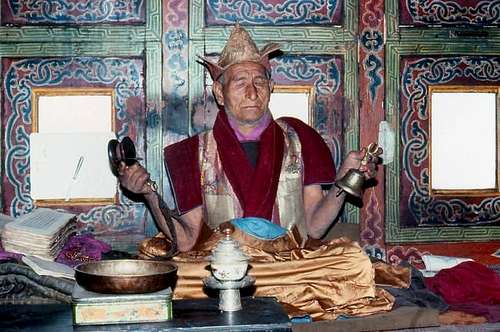
Buddhist priest in 1982 on the walk in from Juri
Partial Equipment list info:
Here is a brief incomplete list for you. Minus the Climbing gear
- 6-pairs socks
- 6-underwear
- 2-pairs of shorts for the walk in
- 3-T-shirts for the walk in
- 2-bandanas or a sun hat to keep off the sun
- Sunscreen, sunscreen, sunscreen plus zinc
- Good sturdy hiking shoes
- 1-sleeping bag (as warm as you can get)
- 1-sleeping pad (your choice the more comfortable you are the better you sleep the more energy you will have) you can get a Crazy Creek chair that goes with your pad this is a good investment.
- 2-expedition weight Patagonia long underwear tops (or 1 depends on how dirty you like to be)
- 1-expedition weight Patagonia long underwear bottom
- 1 lightweight fleece bottom
- 1-heavy weight Patagonia or similar fleece jacket
- 1-Gortex shell jacket
- 1-Gortex shell pants (full length zippers)
- 1-Down filled jacket liner from Feathered Friends of Seattle, (optional but I always end up using it)
- 1-D own filled Gortex guides Parka 1-Warm hat with ear flaps
- 2-pairs of heavy duty mittens (in case you lose one pair up high)
- 1-pair fleece gloves 1-pair ski gloves
- 1-pair of Koflach double plastic boots, One Sport (much warmer)($$$) or Asolo (I prefer Koflach, I find them more comfortable)
- 1-pair of gaitors (Super Gators)
- 1-pair ski poles
- 1-ice axe
- 1-pair of sharp crampons (test them on your boots before you leave and make sure they fit perfectly)
- 1-headlamp with extra batteries a nd bulbs
- 1-cup with spoon attached
- 1-Swissarmy knife
- 1- stove of your choice (I use Markhill stormy hanging stone with Blueway cartridges, you will have to get fuel in Nepal as it is difficult to fly over) Allow at least 1 canister per day for up high per 2-man tent.
- 1-4 tents one set up at base camp. one at camp 1, and another 2 for higher up. 3-1-litre waterbottles with insulators (drink at LEAST 5 litres a day to help acclimatize) Food....
Political Situation in Nepal
Note on Nepal. There had been a cease fire and talks between the Government and the Maoist who were causing issues in parts of the country. This has led to them being included in the government. Lets hope this coalition holds so that locals, trekkers and climbers can all enjoy this wonderful place in peace.
After 10 years of civil war (1996-2006), general elections were held in 2008 and the monarchy abolished. However, political stability is yet to be achieved, with no less than three Prime Ministers since 2008, and the new constitution still under discussion.
External Links
- Link to Alan's site with pictures
- Everest Web Cam
- 360 Degree Panoramic
This is a 360 degree panoramic shot from the summit of Everest. Very cool! - Trek to Kharta region
From the Chinese side to view the rarely seen east (Kangshung) face of Everest. Great photos. - 8000ers Everest General Info
 1 Routes
Alpinist - Mar 2, 2007 7:44 pm - Voted 10/10
Broken mapFYI William - the map window is broken in the Getting There section. Cheers.
William Marler - Mar 2, 2007 11:32 pm - Hasn't voted
Re: Broken mapThanks. They seem to be breaking a lot. Cheers William
Damien Gildea - Mar 11, 2007 9:46 pm - Hasn't voted
Ed +W I see you've still got a couple of misspellings of Hillary's name - Edmund, not Edmound/Edmond. Also, why have those speed records and the first Canadian ascent in the table*, but not the 1980 Japanese FA of the Supercouloir or the 1984 Australian FA of the (Great) Norton Couloir ? The Japanese did the FA of the N face, not Messner and these are the two major routes on the face, more significant than the 1986 Canadians on the W ridge. I know I'm a bad person and all, but this is basic stuff and a bit disappointing in the page that is supposedly the best on SP, if I'm reading this new 'Best of ' page right. D * aside from you being Canadian, I mean :-)
William Marler - Mar 11, 2007 11:39 pm - Hasn't voted
Re: Ed +Hi Damien. I only placed summit events that I found in books I have. The books I have list the Canadian achievements as well so I have included. I realize I am Canadian but its is not like I made it Bolder or highlighted it. I had an Italian ask me to include an ascent from the 80's that I could not find anywhere. I didn't because I could not verify the truth of what was sent me. Its is not the official summit log by far. (•: (I never claimed it to be the best on SP. I only do the best I can with the time I can afford to the project.) Sorry on all the Edmunds... thought I had caught all those a while back. (you are not the first to point them out). I will try and fix. Thanks for all the Antartic emails. Cheers William
Damien Gildea - Mar 12, 2007 8:59 am - Hasn't voted
Re: Ed +W No worries. I actually only visited the page on this occasion because it was at: http://www.summitpost.org/list/276981/the-five-best-quality-pages.html Isn't there another Top 10 somewhere too ? Peter Gillman's book on Everest gives a good overview on the history, but you could also go down the list at adventurestats.com and pick out all the FAs. Keep up the good work. D
William Marler - Mar 12, 2007 3:11 pm - Hasn't voted
Re: Ed +Thanks I will check it out. Cheers William
BigLee - Jun 5, 2007 5:17 pm - Hasn't voted
More ascentsOne for your table... Pemba Dorje Sherpa, new speed record, 8 hours and 10 minutes on May 21, 2004
William Marler - Jun 6, 2007 4:49 pm - Hasn't voted
Re: More ascentsThanks I will add when I get a moment free. Cheers William
darknight - Sep 29, 2007 9:05 am - Voted 10/10
about Elevationthe exact Elevation of everst is 8844.43m . sir
William Marler - Sep 29, 2007 2:46 pm - Hasn't voted
Re: about ElevationDoes that translate to 29,028 feet? If so that is the old altitude mark. Was revised 10 years ago to 29,035 ft. If I have it wrong please provide a source where I can verify this. The altitude I have posted is what I find everywhere I have read. Let me know if I have missed a new measurement. Thanks and Cheers William
kamil - Oct 9, 2007 2:25 pm - Voted 10/10
winter ascentLeszek Cichy and Krzysztof Wielicki February 17 th, 1980, Polish expedition, leader Andrzej Zawada. Route: Normal. It should be added that this was the first winter ascent of Everest :) All in all great page! cheers, kamil
William Marler - Oct 9, 2007 5:49 pm - Hasn't voted
Re: winter ascentThanks. By Normal do you mean south Col? Cheers William
kamil - Oct 9, 2007 5:55 pm - Voted 10/10
Re: winter ascentYes, that was via South Col, I pasted the text from the chart at the Everest main page. cheers, k
William Marler - Oct 10, 2007 12:18 pm - Hasn't voted
Re: winter ascentThanks. Yes I figured that out when I went to edit the chart. Thanks again. Cheers William
Diego Sahagún - Oct 27, 2008 8:09 pm - Voted 10/10
El largo camino de Yorkshire al Everesthttp://www.desnivel.com/newsletter/desnivelaldia/object.php?o=17710&p=noticia.3/noticia.3.1.php&print=
Bruno - Mar 9, 2011 8:04 am - Hasn't voted
Some update and correctionsThanks William for this nice page. In my opinion a few points would deserve some update or correction though: 1) "Altitude 29035 ft / 8850 m" Even though the National Geographic survey from 1999 gave an altitude of 8850m, this measurement is neither recognised by Nepal nor China, and I think the altitude of 8848m (29029ft), should remain the golden standard. In 2005, the Chinese measured it at 8844.4m, but this is the bedrock altitude, to which approx. 3.5m of snow cover should be added, making their measurement consistent with the earlier measurement at 8848m. Most authoritative sources give an altitude of 8848m. 2) ""Sagarmatha" meaning "Goddess of the Sky" to the Sherpa people, (invented in the 1960s by Baburam Acharya in response the the rising question that the Mountain had no Nepalese name)" No, Sherpa people, who speak a variation of the Tibetan language, also call it Chomolungma, like Tibetans. As you mentioned, Sagarmatha was invented later to give it a Nepalese name, but Sherpa continue to call it Chomolungma. 3) The ancient name for the mountain is Devgiri, meaning "holy mountain" or Devadurga may have been pronounced it as deodungha by the English in the 1800s Here again, the most ancient name is Chomolungma, as the mountain was named by people living in its surrounding both north (Tibetans) and South (Sherpa). Devadurga might have been the (Sanskrit) name in use in the 19th century, but this is certainly neither the local nor the most ancient name. 4) "The fall of the same year 1951 [...]. This time the mountain was to be attempted by the south col route in Nepal. The team succeeded in getting above the icefall but no further and were unsuccessful." To my knowledge they actually did not reach the top of the icefall, even though they were closed to it. 5) The spring of 1952 saw a team of Swiss [...]. Halted by bad weather in the south col this team was unsuccessful. The Swiss were not halted by the bad weather at the South Col, and Lambert/Tenzing did indeed reach an altitude of 8600m, higher than anybody at that time (assuming Mallory/Irvine did not make it higher in 1924). It is actually this expedition, which "opened" the S Col / SE ridge route, successfully climbed by the British expedition a year later. 6) Some notable successes Worth to add would be the 1986 climb by Loretan/Troillet through the North Face (Hornbein Couloir) in pure alpine style, without oxygen and in 43 hours go and back (summit on 30 August 1986). 7) Getting there The link to the picture seems to be broken 8) Getting there Would be worth to add some more info on the approach via Tibet, as since 20 years a significant number of climbs are made from the North (check Corax or my pages for approaches via Tibet). BC is reachable by road (100km off the Friendship highway between Shelkar and Tingri). 9) Getting there. "To get to Nepal you will have to fly from either India, Thailand or Singapore" I'm pretty sure there many more options than transiting through India, Thailand or Singapore nowadays. Just to mention one example, Qatar Airways via Doha is a popular option from Europe. 10) Getting there. "Royal Air Nepal" The link doesn't work, and "Royal Air Nepal" has been renamed since "Nepal Airlines", see http://www.nepalairlines.com.np/ 11) Getting there. " Fly on Royal Air Nepal's Twin Otter flights to Lukla" See above for "Royal Air Nepal". Other airlines do also flight to Lukla, see http://en.wikipedia.org/wiki/Tenzing-Hillary_Airport 12) Getting there: "Note on recent bus cancellation to Juri" Outdated information, the whole paragraph can be removed. 13) Red tape Would be good to add the address of CTMA for the climb from Tibet side. 14) The walk-in from Lukla Would be nice if the altitude is not only given in feet, but also in meters. 15) Guided climbs Could be nice to add a couple of Nepalese outfitter to your list of commercial guiding services, such as Asian Trekking, Monterosa, Thamserku, in order not to have only western companies. 16) Political situation in Nepal Outdated. Your text seems to be related to the 2006-2008 transition period between the peace agreement and the elections. The chapter can be dropped altogether, or just make mention that after 10 years of civil war (1996-2006), general elections were hold in 2008 and the monarchy abolished. However, political stability is yet to be achieved, with no less than three Prime Ministers since 2008, and the new constitution still under discussion... 17) Image for deletion I don't know what this chapter is. Can be removed. 18) External links Could be nice to add the following link, which is much more accurate and updated than adventurestats: http://www.8000ers.com/cms/everest-general-info-185.html Cheers, Bruno
William Marler - Mar 10, 2011 1:37 pm - Hasn't voted
Re: Some update and correctionsThanks Bruno for the research. I will try an incorporated some of your requests when I have a moment. Let me digest and see what I can do. Regards William
Bruno - Mar 13, 2011 4:13 am - Hasn't voted
Re: Some update and correctionsHi William, Please take your time, most of the points I mentioned are rather details. Most important in my opinion is the naming of the mountain by Sherpas. An additional precision regarding the two 1952 Swiss Expeditions that took place in spring and autumn (you quoted:"The spring of 1952 saw a team of Swiss [...]. Halted by bad weather in the south col this team was unsuccessful"). Actually the Himalayan Database mention the following reasons for the abandon of the Swiss spring expedition: "Lack of supplies and equipment / Abandoned at 8600m due to fatigue". Always according to the Himalayan Database, it is the autumn expedition which abandoned due to bad weather at 8100m, just above south col: "Bad weather (storms, high winds)". Cheers, Bruno
Gabriele Roth - May 19, 2011 2:37 pm - Hasn't voted
new webcampeterpyr - Aug 21, 2014 5:10 pm - Hasn't voted
Everest webcamEverest webcam has been installed by me and my staff under the activity of Ev-K2-CNR International Research Center the Pyramid at Lobuche, 5000 masl: http://www.evk2cnr.org/cms/en/evk2cnr_committee/pyramid The Everest webcam shows south col and the final Pyramid above 8000, here the evaluation of wikipedia: http://en.wikipedia.org/wiki/Mount_Everest_webcam To see Everest go here: http://www.evk2cnr.org/WebCams/PyramidOne/everest-webcam.html Please consider during monsoon (june to september) visibility can be limited, consider also Nepal time: UTC + 5:45 Pls contact me here gpverza@gmail.com for any further informations. Thanks to Italian Council of Researches, to Nepal Academy of Science and Tecnology, and to Mobotics for equpipment. Peterpyr