


 Page Type:
|
Mountain/Rock |
|---|---|
 Lat/Lon:
|
37.86230°N / 107.7802°W |
 County:
|
San Juan & San Miguel |
 Activities:
|
Scrambling |
 Season:
|
Summer |
|
Elevation:
|
13661 ft / 4164 m |

|
Overview
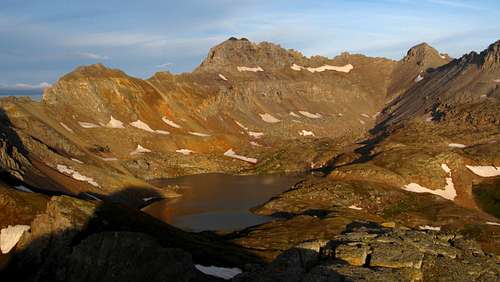
Lookout Peak above Columbine Lake from the east
At 13,661', Lookout Peak is among the highest 200 peaks in Colorado (known as the bicentennials). It is often remarked that Lookout Peak has a very fitting name as the views from the top extend far in every direction without obstruction. Although it is only three miles to a higher peak (U.S. Grant Peak), Lookout Peak's lineage follows the ridge divide of the Telluride section of the Sneffels Range all the way to the next higher peak, Gilpin Peak, 8.5 miles away, and over 12 miles away following the ridge. The saddle between Lookout Peak and U.S. Grant Peak at Ophir Pass is under 11,800', giving the south side of Lookout Peak nearly 1,900' of relief. This combined with the distance to its line parent, Lookout Peak stands out as a peak very much on its own despite a lack of literal topographic prominence. The northern side of the peak is near vertical in many places and the poor quality of rock in the area makes a ascent that stays entirely on the north side unreasonable. The book Colorado Scrambles by Dave Cooper has a section dedicated to this peak and provides some detail for the South Ridge Route.
Scenery

Views from Columbine Lake on the peak's north side

View south toward Ice Lakes Basin from Lookout Peak

View west from Lookout Peak toward San Joaquin Ridge and Silver Mountain B
Access and Camping
Ouray info: ouraycolorado.com
Telluride info: en.wikipedia.org/wiki/Telluride,_Colorado
Ridgway info: ridgwaycolorado.com
Parks and Camping:
Ouray Area Parks and Camping
Telluride Area Parks and Camping

View to the east from Lookout Peak
Current Conditions and Forecast
The San Juan Range in general and particularly the Ouray/Silverton area melts out late.
Current Snowpack
 1 Routes
seth@LOKI - Jul 7, 2015 10:57 pm - Voted 10/10
RangeNorth of Ophir Pass would be Sneffels Range?