

-
 23076 Hits
-
 89.01% Score
-
 28 Votes
 Page Type:
|
Area/Range |
|---|---|
 Lat/Lon:
|
32.23620°N / 111.1101°W |

|
Overview
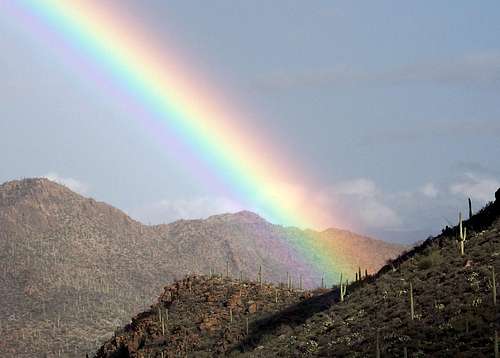 Rainbow over Gates Pass
The Tucson Mountains are a range small in scale and short in stature, but big on beauty and bold in ruggedness. The lowest of the four mountain ranges immediately surrounding the city of Tucson (the others are the Santa Catalina Mountains, the Rincon Mountains and the Santa Rita Mountains) they are nonetheless the mountains that really yell “Tucson!”. These peaks capture the character of this area so well.
Rocky and scrappy desert peaks, the Tucson Mountains provide a lot of bang for the buck. Several require brave desert bushwacks and rock scrambles to reach the summit and most provide interesting views of the interface between urban Tucson and the wild desert mountain landscape.
What really makes a trip to the Tucson Mountains a special treat is the Sonoran Desert landscape. The rich desert diversity in plantlife and the stalwart critters that call this desert home render this mountain range a special retreat for Tucson locals and an exciting departure from the norm for visitors. This compact little range of exciting peaks is an understated gem of the Arizona landscape.
| Learn more about the facinating geology of the Tucson Mountains in this Tucson Citizen article about Tucson Mountain Chaos geological phenomenon. |
Getting There


The Tucson Mountains sit just to the west of the city of Tucson, Arizona. The mountain range is bounded roughly by I-10 to the east and Hwy 86 to the south. The Tucson International Airport is serviced by 9 airlines providing 60 daily departing flights to 15 destinations.
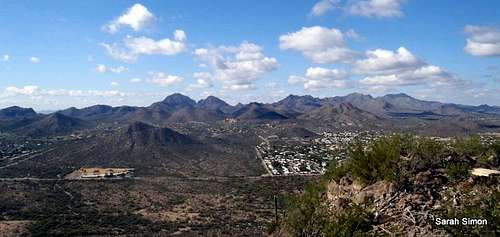 Tucson Mountains from Tumamoc Hill
Notable Peaks of the Tucson Mountains
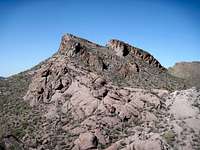 "Little Cat Mountain"
 Cat Mountain
| Peak | Elevation | SP Page? |
|---|---|---|
| Wasson Peak | 4687 ft | Yes |
| Amole Peak | 4450 ft | Yes |
| Golden Gate Mountain | 4288 ft | Yes |
| Tower Peak | 4170 ft | No |
| Bushmaster Peak | 4140 ft | No |
| Bren's | 3988 ft | Yes |
| Cat Mountain | 3852 ft | Yes |
| Safford Peak | 3563 ft | Yes |
| Panther Peak | 3435 ft | No |
| UN 3380 | 3380 ft | Yes |
| Brown Mountain | 3098 ft | Yes |
| Apache Peak | 3075 ft | No |
| UN 3330 "Little Cat Mountain" | 3030 ft | Yes |
Flora and Fauna
 Saguaro on UN 3380
 Saguaro Close-Up
The Sonoran Desert has captured the hearts of many. The combination here of the rocky and rugged Tucson Mountains blanketed in rich Sonoran beauty is especially striking. This extremely dry and very hot area hosts unique plant and animal life, all adapted in special ways to the challenge of surviving in this desert.

Hardy desert plants include cat’s claw acacia, fishhook barrel cactus, prickly pear, numerous types of cholla, palo verde and the famous saguaro.
 |
 |
 |
 Ringtail on Safford Peak
Numerous types of mammals, birds, amphibians and reptiles call the Tucson Mountains home. According to the Saguaro National Park website, coyote, Gambel’s quail, and desert tortoise are some of the more common denizens. These mountains also are home to desert pack rats, several types of toads and frogs, numerous kinds of birds including Anna’s Hummingbird, Cactus wren, and Harris’s Hawk as well as greater roadrunners and Gila woodpeckers. Reptiles in the Tucson Mountains include Gila monsters several species of rattlesnakes! Mountain lions, Javelina and jackrabbits also live in the Tucson Mountains.
| Learn more about the University of Arizona's efforts to study big cats (mountain lions and bobcats) in the Tucson Mountains on this Wild Cat Research page. |
Area Attractions
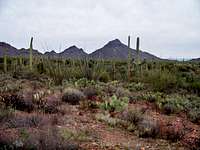 Across the desert floor toward Gates Pass area
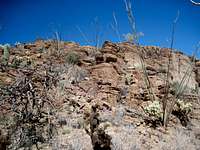 Natural Sonoran Rock Garden
There is a lot to do in the Tucson Mountains in addition to touching their summits.
• The Tucson Mountains form the rugged backdrop of Tucson Studios, where many famous westerns were filmed.
• Cat Mountain Station is named in honor of a rugged desert peak and features a restaurant (Coyote Pause) as well as a collection of merchants and artisans.
• The Tucson Mountain District (Western parcel) of Saguaro National Park provides additional hiking, scenic drives and a well-done educational visitors center.
• The Arizona-Sonora Desert Museum boasts that it provides “a world-renowned zoo, natural history museum and botanical garden, all in one place!”
Land Ownership and Management
 Sonoran Desert Cholla
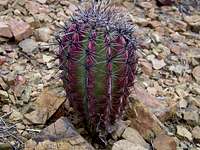 Young cactus pushing through rocky soil
The two primary land management entities in the Tucson Mountains are Tucson Mountain Park and Saguaro National Park. The mountain range is almost entirely surrounded by private land, but the vast majority of the range is accessible to the public.
Camping & Lodging
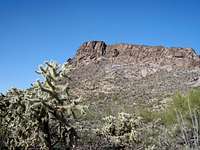 "Little Cat Mountain" from desert below
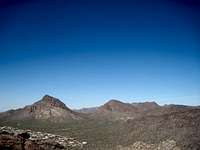 Gates Pass from "Little Cat Mountain"
The primary area campground is the 130-site Gilbert Ray Campground, located in Tucson Mountain Park.
Note that there is no car camping available in the western district of Saguaro National Park.
The proximity of the Tucson Metro to the Tucson Mountains area means lodging options are virtually unlimited. Visit the Trip Advisor site covering Tucson, AZ, for more information about area accommodations.
Weather & Seasons
| *Most hikes in the Tucson Mountains, thanks to their low elevation, would be most comfortable in the fall, winter or spring. *March and April are primo wildflower viewing months. *Summer temperatures in this part of the Sonoran desert can be worse than uncomfortable; they can be downright dangerous! *According to the United States National Weather Service, the record high temperature for Tucson, Arizona, set on 26th June 1990, was 117 degrees Farenheit / 47 degrees Celsius. |


Resources for Climbers
Organization Name: Southern Arizona Climbers Coalition - SACCWebsite: www.gosacc.com
Our Mission: The Southern Arizona Climbers Coalition (SACC) is an advocacy group dedicated to conserving and enhancing the climbing environment through stewardship, education & community. Please learn more about us by visiting our website. We offer local information on closures, access issues, and stewardship/social events you can participate in. If you are interested in becoming a member we encourage you to come meet us at our assembly meetings or contact us via our website. We're excited to meet you!
Bouldering
Per SP Member Hans-Schank, there is some great bouldering near Gates Pass. When I lived in Tucson, I would frequent the area. I think it is worth mentioning. Mountain Project has many of the routes listed at Mountain Project
 11 Mountains & Rocks
hans.schenk - Nov 27, 2015 2:23 pm - Voted 10/10
Gates Pass BouldersThere is some great bouldering near Gates Pass. When I lived in Tucson, I would frequent the area. I think it is worth mentioning. Mountain Project has many of the routes listed at https://www.mountainproject.com/v/gates-pass/105738028
Sarah Simon - Feb 9, 2016 3:02 pm - Hasn't voted
Re: Gates Pass BouldersThanks for the input! I've made a note to execute the addition when I turn on my PC next! Climb safely, Sarah
Sarah Simon - Dec 20, 2016 5:26 pm - Hasn't voted
Re: Gates Pass BouldersSorry, buddy, it took me 10 months to make that update. It got buried in my inbox. Safe climbing! -Sarah