
| Glasgwm/Craig Cywarch Mountain/Rock |
Contribute  Loading... Children  Loading...
Geography Parents  Loading... Mountains & Rocks
| Glasgwm/Craig Cywarch   | 
| Page Type: Mountain/Rock Location: Snowdonia, Wales, Europe Lat/Lon: 52.76094°N / 3.72439°W County: Gwynedd Activities: Hiking, Trad Climbing, Bouldering, Mixed Season: Spring, Summer, Fall, Winter Elevation: 2559 ft / 780 m | Page By: Nanuls Created/Edited: Sep 17, 2008 / Apr 15, 2011 Object ID: 443940 Hits: 3226  Loading... Page Score: 89.02% - 23 Votes  Loading... Vote: Log in to vote |
"The upper part of this valley [Cwm Cywarch] with its great crags and scree slopes, its mineral-rich rocks, its gorges and cascades, and its remoteness from internal combustion engines, is a place that deserves to be set aside and safeguarded from every threat of change or exploitation"
William Condry, naturalist (1918-1998) |
The unassuming grassy hill of Glasgwm harbours something of a schizophrenic personality. On the one hand the mountain is cursed with a completely uninspiring summit area - it’s flat, it’s round and it’s criss-crossed by a maze of fences. There’s little here to keep even the most ardent of hill-goer happy. On the other hand, tucked away under its sheltered eastern flank, is Craig Cywarch, a 3km long series of crags and buttresses which are home to the greatest density of rock climbs in Mid Wales. And thank God, because otherwise this hill would be completely without merit. Craig Cywarch is Glasgwm’s principle point of interest (hence the twin title), and it’s this feature that this page will mostly focus upon. It has to, if it were to focus on any other part of the mountain, it would be a very short page indeed.
So as a quick introduction let’s throw out a few facts. Glasgwm’s summit is 780 metres above sea level and has a prominence of 213 metres. For the peak baggers out there, this is enough to qualify it as a Marilyn, a Hewitt, a Nuttall and a Buxton & Lewis, the latter of which is going to be of interest to no one but the most dogged of list tickers. The bulk of Craig Cywarch is located between around 300 and 600 metres above sea level, placing its crags within a relatively short distance of the nearest road. The nearest road by the way is not much more than a single lane track which services a few farms in the upper reaches of the valley. It’s this remoteness that helps make the experience of climbing here so special.
Placing the crag in a geographical context is a little tricky. Although it’s located within the boundary of the Snowdonia National Park, the surrounding landscape bares little resemblance to the rugged terrains that the park is best known for. Rather, Glasgwm’s rounded profile is homogeneous with the more subdued hills of the Cambrian Mountains to the south. The crags have a uniquely Welsh quality; they sit perfectly on the hillside dominating the lush, grassy valley of Cwm Cywarch below; commanding a vista which is both grand in scale and intimate in feel. |
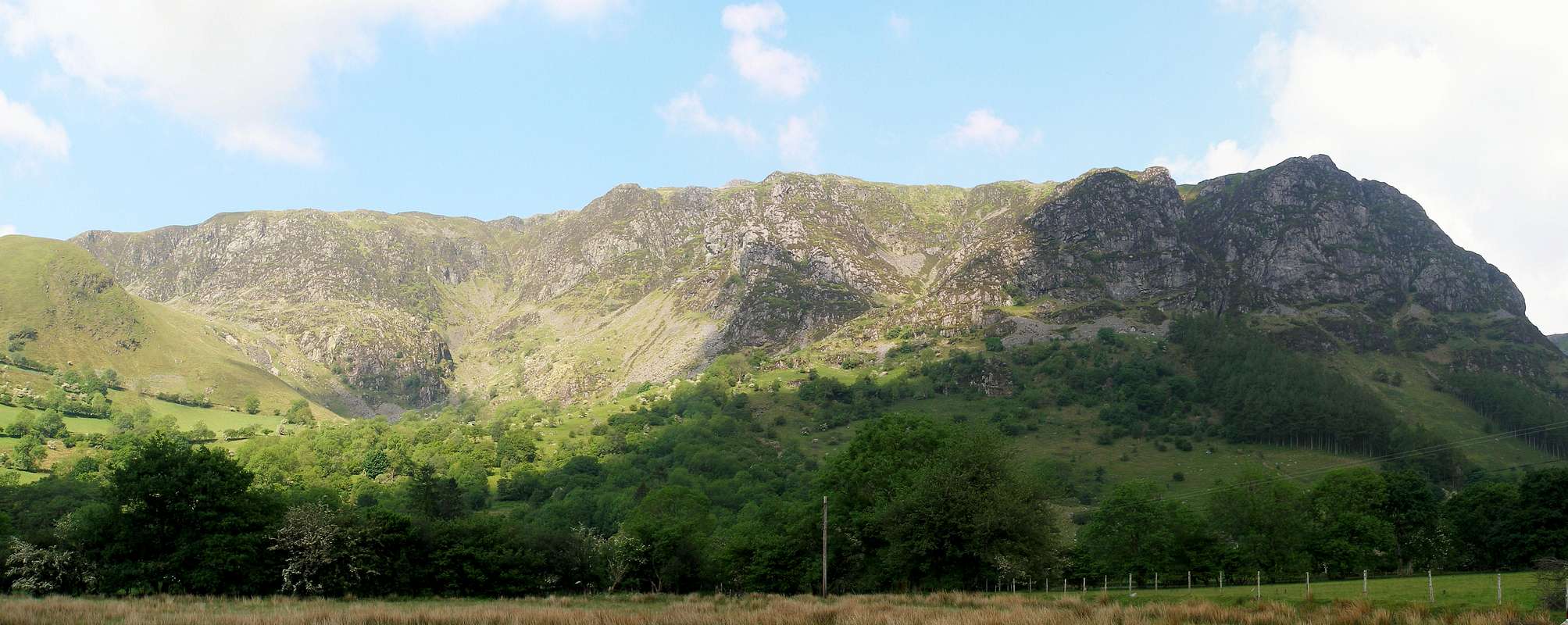
Craig Cywarch (Photo by Nanuls) |
The crags offer a range climbs starting at Moderate and working their way all the way up to E7. The igneous rock generally offers good holds and protection, however most of the lines are rarely ascended and some of the least used can involve more ‘gardening’ than actual rock climbing. Another consideration is that Mid Wales’ rock is frustratingly adept at holding onto water, even after a day or so of clear weather. When wet, the rock becomes very greasy and all but the very easiest of routes should probably be avoided. Aside from the physical difficulties that climbing on wet rock poses, constantly having to clear soggy vegetation from a route is a thankless task, particularly if you are seconding and have to endure a constant shower of wet moss and lichen. This effectively limits the climbing season to the beginning of March at the earliest, to the end of October at the latest; of course if a nice big high comes along and sits over the area for a week or so you might get lucky!
Historically the area around Craig Cywarch was exploited for its lead deposits, and mines existed in the valley right up until the beginning of the 20th century. Today many of the farms have converted old mine buildings and mills into houses and barns. Some of the workings still exist and many of the approaches to the crag follow old miner’s tracks and tramways. Prior to the discovery of exploitable metals, the area was considered to be a wild and remote corner of Wales. During the 16th century the valley was home to a band of outlaws known as Cochion Cywarch (The Reds of Cywarch ), apparently so called after the colour of their leaders hair. The band terrorized the region and gained such notoriety that they now have a pub – The Brigand’s Inn – named after them in the nearby village of Mallwyd. The area has a strong cultural tradition; Ellis Wynne composed Gweledigaetheu y Bardd Cwsc - 'Visions of the Sleeping Bard' (1703), one of the most influential pieces of Welsh Language Literature ever written, just down the road in Aber Cywarch (which you must drive through to reach the crag). |
Climbing began on Craig Cywarch in the first decade of the 20th century when on Easter 1907 a Rucksack Club (a Manchester based club founded in 1902) party led by C.H. Pickstone visited the crag and recorded climbs on the three main gullies. Unfortunately they neglected to record any other climbs in the area, so any other first ascents climbed on that preliminary weekend are now lost to history. For the next 40 years or so very little occurred on Craig Cywarch, until in 1950 when Norman Horsfield, who, after reading some old Rucksack Club Journals, partnered up with Peter Harding and decided to explore the crag, and so began a new age of exploration in the area. In 1954 the Staffordshire based Mountain Club gained the use of an old farm house at the head of the valley at Tyn-y-Twll, increasing the popularity of Craig Cywarch immeasurably. By 1957 over 50 routes had been recorded and in 1958 the first guidebook, written by R.E. Lambe, was published. In 1960 The Mountain Club began construction on their own hut on the site of an old derelict mine building. The hut was christened Bryn Hafod, and to celebrate its opening a party was held to which all the local farmers were invited. This close relationship between the Mountain Club and local landowners has resulted in unrestricted access to the crags, a remarkable achievement in an area which is notorious for its access issues.
The 60s bought such legends as Chris Bonnington and Joe Brown to the area who recorded several new lines on Sawdl y Graig and Gist Ddu. However it would be members of the Mountain Club who would dominate the Arans for the next 10 years or so, with John Sumner, Barry Knox and Dave Adcock continuing the extensive exploration which they began in the late 1950s. The ever popular Will o' the Wisp (HVD) was a product of this era. The late 70s and early 80s bought a new generation of climbers to the area, and the climbing standards were again raised. The 90s bought fourth a flurry of new routes, and over a weeks holiday in 1994 Martin Crocker and John Harwood opened up some of the area's finest climbs, culminating in the area's hardest line, the epic Sci-Fi (E7 6b). |
Interactive Map | This map of Glasgwm shows the main crags and outcrops of Craig Cywarch. You can get information on the crags, which will appear in the right hand box by hovering your moose cursor over the map symbols. For an annotated printable map click HERE. |
An XHTML 1.0 Strict standard template -
Creigiau Camddwr2 routes - E2 5b to E3 5b A series of small crags on the northern side of Cwm Cywarch almost directly opposite Creigiau Sawdl Efa. They have only two recorded climbs but have huge potential for bouldering, and no doubt many unrecorded problems have troubled climbers past. If you’re going to boulder here however, just beware of the potential 150m roll down the mountain side if you fall!
Creigiau Sawdl Efa5 routes - D to HVS 5a An small area of short steep crags on the far northern tail of Craig Cywarch. The crag can be located by an obvious grassy ledge that runs under the main wall.
Dinas Llywelyn1 route – HVS 5a A subsidiary of the Ffenestr y Graig area, Dinas Llywelyn is a striking tower that sits in the gully that separates its parent crag from Creigiau Sawdl Efa in the west. The tower sports only one route – King Edward's Army (HVS 5a).
Ffenestr y Graig20 routes – S to E6 6b A steep area of rock that sits above and to the right of Craig Llywelyn. The crag is home to a number of excellent routes including Learning to Fly (E3 5c), Quartizone (E6 6b) and Keel Haul (E2 5b).
Craig Llywelyn19 routes – VD to E5 6a An outstanding line of crags which run along most of Craig Cywarch's northern slope. Its main attraction is the 120 metre rib which runs up its full height and gives what are probably the best VS (Doom VS 4b) and HVS (Acheron HVS 5a) in the Arans, if not the whole of southern Snowdonia.
Sawdl y Graig19 routes - D to E6 6b A 75 metre high nose of rock, bounded on the left by North Gully and on the right by a line of grassy terraces. Highlights include Charon (E1 5b) and Hades (E1 5a).
Hafn Mawr18 routes – VD to E5 6b A series of buttresses consisting of Tap Isa Hafn Mawr, Tap Uchaf Hafn Mawr and the North-North-East Towers. Those with a grasp of Welsh will have deduced that Tap Uchaf Hafn Mawr sits above Tap Isa Hafn Mawr – everyone else will just have to take my word for it; the North-North-East Towers are located just below Hafn Mawr directly above the approach path. Sickle Wall (S 4b) and The Scythe (VS 4a), both on Tap Isa Hafn Mawr, are probably the best climbs the buttresses have to offer.
Esgair Felen16 routes – M to E1 5b This area comprises of two separate crags; Esgair Felen Uchaf, which is sandwiched between Great Gully on the left and North Gully on the right; and Esgair Felen Isaf which is located below the main rock face close to the approach path. Esgair Felen Uchaf has the best routes with Shade of Pale (E1 5b) being the finest. Esgair Felen Isaf is now rather vegetated, but does offer a number of easy climbs which have been the staple of local outdoor centres for decades and offer some fun solo opportunities for the more experienced.
Tap y Graig38 routes – D to E2 5c Sitting between Little Gully on the left and Great Gully of the right, Tap y Graig is the large buttress that dominates much of Craig Cywarch's east face. The face is split into 8 separate sections (from left to right) – Little Gully Wall, Will-o'-the-Wisp Wall, Baskerville Wall, Thung Wall, Brik-a-brac Wall, The Upper Wall, Tap Dwyren (which is a crag above the main wall – see map) and Great Gully. The buttress is home to Craig Cywarch's most popular climb, the excellent Will-o'-the-Wisp (HVD) which takes a rising traverse across the left hand portion of the crag. Other highlights include Sweet Baby James (HVS 5a), Bluebell Babylon (VS 4b) and A Touch of Class (VD).
Tap Mawr27 routes – M to E5 6b A large triangular shaped buttress located between Cwm Bydyre and Little Gully, Tap Mawr towers above the second plantation. Its upper and lower tiers are separated by a large grassy terrace which runs the length of the crag. The lower tier is very steep, with roofs and overhangs providing some excellent hard routes. unfortunately an over-abundance of vegetation and a series of grassy rakes spoil the continuity of the crag and limits the number of truly impressive routes. Located just below the right hand end and just left of the fence running up from the left hand end of the second plantation is a little tower known as The Old Man of Cywarch. There are a number of short routes on it ranging from D to VS.
Tap y Gigfran33 routes – M to E7 6b Tap y Gigfran sits between the valleys of Cwm yr Ychen on the left, and Cwm Bydyre on the right. It has two main faces – the first is the imposing South Face which overlooks Cwm yr Yechen and is home to Craig Cywarch's hardest route - Sci-Fi (E7 6b); and the second is the Eastern Slabs, which has two further subsidiary crags – the North Wing Upper Buttress and North Wing Lower Buttress. Although less frequented than its northern neighbours and being a little 'veggier' in character than most people would like, Tap y Gigfran has some fantastic climbs all within close proximity of one another. Some of the best include Dream Racer (E2 5c), Purge (E3 5c), Crozzley Wall (E4 5c) and Rolair (E3 6a).
Tap Rhygan Ddu13 routes – S to E6 6b Concealed high up on the northern side of the appropriately named Hidden Cwm, and just above the obvious feature of Tap y Gigfran, this steep rock face offers some of the most exciting routes on Craig Cywarch. With the exception of Shady Saunter (Severe) all the climbs are at the harder end of the spectrum, the hardest of which is The Devil Within (E6 6b) which takes a spectacular line directly over the large overhanging feature which dominates the rock face.
Hidden Cwm1 route – VD The Hidden Cwm lies between Tap y Gornel and Tap Rhygan Ddu, and over the years has produced several very short routes of a rather scrappy nature. The only route worth doing in the area is Knockdown, a 60m, 4 pitch Very Difficult, which takes the arête on Mur Goch high up on the southern side of the valley.
Cwm yr Ychen7 routes – D to E2 5b Cwm yr Ychen is the valley just north of Tap Pant Cae and is used here to group a number of small crags in its upper reaches. Its most interesting feature is the short pinnacle known as Maen Hir which has a handful of interesting lines ascending its various aspects. The other two crags in the group, Craig Maen Hir and Craig y Gornel, are less interesting and share only three routes between them.
Tap Pant Cae112 routes – S to E6 6a Wet and vegetated in places Tap Pant Cae may seem like an unattractive prospect for most, but its greenish walls do offer some interest for anyone looking for a bit of a challenge. White Ribbon (HS 4a) on its East Face and Basil Brush Stroke (E6 6a) on its North Face are particularly noteworthy.
Pant Lygog7 routes – VD to E6 6b Pant Lygog is a hanging valley boasting an assortment of broken buttresses and small crags. Arguably the best of these is the V-shaped Tapiau Geifr which is home to a couple of interesting multi pitch routes – Stronghold (S) and Battlements (HS 4a). One of the area's other crags, The Black Tower, also holds a couple of interesting routes in the form of a couple of short (only 12 metres), but difficult single pitch climbs (or possibly highball bouldering problems) – The Cywarch Finger Flake (E5 6a) and Kangaroo Moon (E6 6b).
|
|
|
|